
Gilgamesh and Enkidu
A king, a wild man, friendship, fame, grief, and the oldest surviving heroic epic.
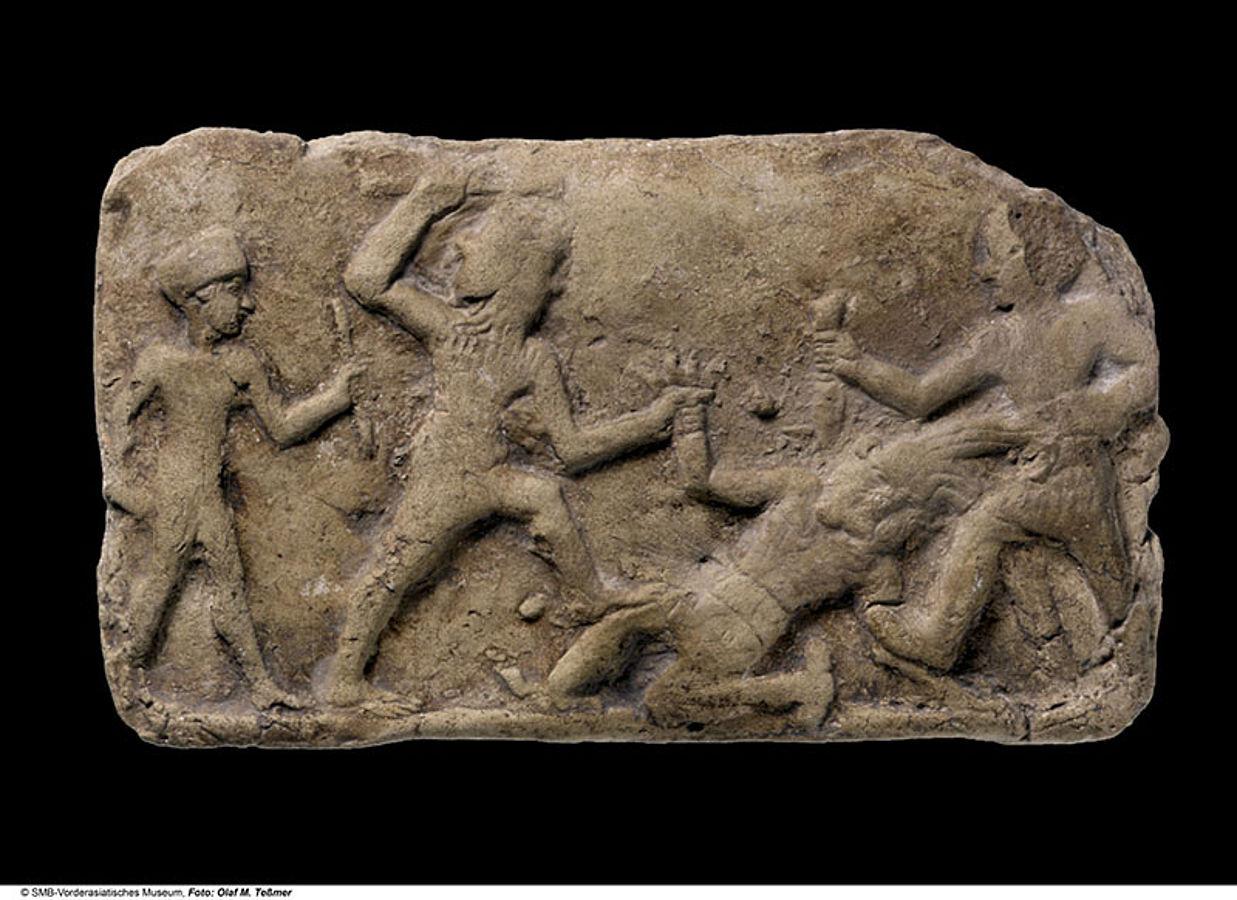
Gilgamesh and Enkidu stand at the center of the oldest surviving epic tradition in world literature. Their story emerged in ancient Mesopotamia, the region between the Tigris and Euphrates rivers that roughly corresponds to modern Iraq. It combines heroic adventure, religious mythology, political reflection, and an unusually powerful account of friendship and grief.
Gilgamesh is presented as the king of Uruk, one of the earliest great cities of southern Mesopotamia. Enkidu is his opposite: a man created by the gods who initially lives beyond the boundaries of human society. One belongs to the city, the other to the wilderness. One possesses authority without restraint, while the other possesses strength without civilization.
When they meet, they do not simply become companions. Each changes the other. Enkidu teaches Gilgamesh compassion, loyalty, and the limits of royal power. Gilgamesh draws Enkidu into human society and gives him friendship, purpose, and fame. Their bond becomes the emotional foundation of the epic and ultimately forces Gilgamesh to confront the one enemy that no hero can defeat: death.
Was Gilgamesh a Historical King?
Gilgamesh may have originated as a historical ruler, although no contemporary inscription from his reign has been found. Mesopotamian tradition placed him among the early kings of Uruk, probably sometime around 2700 BCE. His name also appears in versions of the Sumerian King List, a document that combines historical rulers with legendary figures and impossibly long reigns.
The King List cannot be treated as straightforward historical evidence. It was a literary and political composition designed partly to explain how kingship passed from one city to another. Nevertheless, its inclusion of Gilgamesh suggests that later Mesopotamians remembered him as belonging to the distant age of the first city-kings. The Metropolitan Museum of Art describes him as a legendary ruler who, if historical, would have lived around 2700 BCE. :contentReference[oaicite:1]{index=1}
Over time, the remembered king became a heroic and semi-divine figure. In the standard Babylonian epic, Gilgamesh is described as two-thirds divine and one-third human. His mother is Ninsun, a goddess associated with wisdom, while his father is usually identified as Lugalbanda, another legendary king of Uruk. Gilgamesh possesses extraordinary strength and beauty, but his human portion means that he remains mortal. :contentReference[oaicite:2]{index=2}
Enkidu, by contrast, has no identifiable historical foundation. He belongs entirely to mythology and literature. In early Sumerian stories, he sometimes appears as Gilgamesh’s servant or subordinate. In the later Babylonian epic, however, he becomes Gilgamesh’s equal, companion, and closest friend.
The Development of the Epic
The story known today as The Epic of Gilgamesh was not written by a single author at one moment in history. It developed over many centuries.
Several independent poems about Gilgamesh circulated in Sumerian during the late third and early second millennia BCE. These included stories about his conflict with King Akka, his journey against the forest guardian Huwawa, his battle with the Bull of Heaven, Enkidu’s descent into the Netherworld, and Gilgamesh’s death. These poems were separate compositions rather than chapters of one continuous epic. :contentReference[oaicite:3]{index=3}
During the Old Babylonian period, scribes began combining Gilgamesh traditions into a more unified Akkadian narrative. Centuries later, a Babylonian scholar traditionally named Sîn-lēqi-unninni shaped the material into the version usually called the Standard Babylonian Epic. Its ancient title came from its opening words, conventionally translated as He Who Saw the Deep.
This version emphasized more than heroic adventure. It examined the misuse of power, the responsibilities of kingship, the meaning of friendship, and humanity’s inability to escape death. Copies and fragments circulated far beyond southern Mesopotamia, reaching places such as Anatolia, Syria, and the Levant. :contentReference[oaicite:4]{index=4}
The best-known surviving tablets came from the royal library of the Assyrian king Ashurbanipal at Nineveh. Archaeologists began recovering the library’s tens of thousands of cuneiform tablets and fragments during the nineteenth century. Because the text survives in broken and incomplete copies from different periods, modern editions must reconstruct the epic by comparing multiple manuscripts. :contentReference[oaicite:5]{index=5}
Gilgamesh the Oppressive King
The epic begins not with Gilgamesh as a wise hero, but as a ruler who cannot control himself.
He is unmatched in strength, and no one in Uruk can oppose him. He forces the young men of the city into exhausting labor and military competition. The surviving text also accuses him of intruding upon marriages and abusing his royal privileges. The precise nature of some of these actions remains uncertain because portions of the tablets are damaged, but the overall picture is clear: Gilgamesh treats his people as instruments of his desires.
The citizens of Uruk appeal to the gods for relief. Rather than destroying or removing Gilgamesh, the gods decide to create someone capable of balancing him. The goddess Aruru forms Enkidu from clay and casts him into the wilderness.
Enkidu is not created as an assassin. He is created as a counterpart. His strength will answer Gilgamesh’s strength, and his presence will redirect the king’s restless energy away from the people of Uruk.
The Creation of Enkidu
Enkidu begins his existence outside human civilization. His body is covered with hair, and he lives among wild animals. He eats grass with gazelles and drinks beside them at watering places. He has no knowledge of cities, clothing, cultivated food, marriage, government, or organized religion.
A trapper eventually encounters him. Enkidu has been destroying traps and freeing animals, making it impossible for the trapper to continue his work. Frightened by the wild man’s strength, the trapper seeks advice and is told to bring a woman named Shamhat to the watering place.
Shamhat is often called a prostitute or temple courtesan in modern translations, although the precise nature of her social and religious position is uncertain. Whatever her formal status, she serves as Enkidu’s guide from the animal world into human society.
When Enkidu approaches the watering place, Shamhat seduces him. Their sexual encounter lasts for several days. Afterward, the animals no longer accept him as one of their own. They flee when he tries to follow them, and Enkidu discovers that his former speed and instinctive connection with the wilderness have diminished.
Yet he has gained something in return. His understanding has expanded. He can speak with Shamhat, listen to her, and comprehend the existence of a world beyond the grasslands. His separation from the animals is both a loss and an awakening.
Shamhat clothes him and brings him among shepherds. There Enkidu learns to eat bread and drink beer, two products strongly associated with settled Mesopotamian civilization. He is washed, anointed with oil, and dressed in human clothing. He takes up weapons and protects the shepherds and their animals from predators.
Enkidu has not merely been domesticated. He has become socially human.
The Meeting of Gilgamesh and Enkidu
Shamhat tells Enkidu about Gilgamesh and the city of Uruk. When Enkidu learns how the king treats his people, he becomes angry and resolves to confront him.
At roughly the same time, Gilgamesh experiences symbolic dreams. His mother, Ninsun, interprets them as signs that a powerful companion is coming. This man will be Gilgamesh’s equal, someone whom he will love deeply and keep close to himself.
Enkidu enters Uruk as Gilgamesh approaches a bridal chamber. He blocks the king’s path, and the two men wrestle. Their struggle is violent enough to shake the building around them. Neither has previously encountered anyone capable of resisting him.
Gilgamesh eventually gains the advantage, but the contest does not end in execution or humiliation. Enkidu recognizes Gilgamesh’s extraordinary qualities, while Gilgamesh recognizes that he has finally encountered someone worthy of his respect.
Their rivalry becomes friendship.
This moment transforms both men. Enkidu’s anger is redirected into loyalty, while Gilgamesh’s uncontrolled strength gains a human focus. The king who treated others as possessions now discovers someone he cannot command through fear.
The language used to describe their relationship is exceptionally intimate. Gilgamesh’s dreams compare his future attachment to Enkidu with the love a man might feel for a wife. Scholars continue to debate whether this language should be understood as romantic, erotic, or as an intense form of heroic friendship. The surviving text does not explicitly describe a sexual relationship between them, but it leaves no doubt that their love is profound and central to the story. :contentReference[oaicite:6]{index=6}
The Journey to the Cedar Forest
Once they become companions, Gilgamesh proposes an expedition to the Cedar Forest. The forest is guarded by Humbaba, called Huwawa in the earlier Sumerian poems. Humbaba is a terrifying supernatural being appointed by the god Enlil to protect the sacred cedars.
Gilgamesh’s motives are not purely noble. He wants timber, adventure, and lasting fame. He knows that human beings must die, but he believes that a heroic name can survive long after the body has vanished.
The elders of Uruk warn him against the journey. Enkidu also understands the danger because of his former knowledge of the wilderness. Humbaba possesses supernatural powers and terrifying radiance. Yet Enkidu ultimately agrees to accompany his friend.
Before they depart, Gilgamesh’s mother Ninsun prays to the sun god Shamash for their protection. She also accepts Enkidu into her family, strengthening the bond between him and Gilgamesh.
During the journey, Gilgamesh repeatedly experiences frightening dreams. Enkidu interprets each dream favorably, assuring him that the gods are promising victory. Their roles have begun to shift. Enkidu, once the wild and uncertain outsider, now steadies the king.
When they reach the forest, Humbaba confronts them. The guardian attempts to frighten and divide the companions. With the assistance of Shamash, however, they overpower him.
Humbaba begs for his life and promises to serve Gilgamesh. Gilgamesh appears momentarily willing to show mercy, but Enkidu urges him to finish what they began. Together they kill the guardian and cut down the cedars.
Their victory gives them the fame Gilgamesh desired, but it also violates a divine boundary. The expedition marks the beginning of their downfall. Their heroism has become inseparable from pride, destruction, and disregard for the gods.
Ishtar and the Bull of Heaven
After returning to Uruk, Gilgamesh washes and dresses in royal clothing. The goddess Ishtar, known as Inanna in Sumerian tradition, sees him and proposes that he become her lover or husband.
Gilgamesh refuses.
His rejection is not cautious or diplomatic. He recites the unhappy fates of Ishtar’s previous lovers and publicly insults her. Furious, Ishtar goes to the sky god Anu and demands the Bull of Heaven so that she can punish Gilgamesh and devastate Uruk.
Anu hesitates because releasing the bull will bring destruction and famine. Ishtar insists, and the Bull of Heaven descends.
The creature opens great pits in the earth and kills many men. Gilgamesh and Enkidu confront it together. Enkidu seizes or restrains the bull while Gilgamesh delivers the killing blow. Their victory is another extraordinary feat, but their behavior afterward deepens the offense. Enkidu tears away part of the bull and throws it toward Ishtar while insulting her.
The two companions celebrate their triumph, apparently believing that no earthly or divine opponent can defeat them.
The gods decide otherwise.
The Death of Enkidu
In a dream, Enkidu sees the gods gathering in council. Because Humbaba and the Bull of Heaven have been killed, one of the two heroes must die. The gods choose Enkidu.
He falls gravely ill.
At first, Enkidu responds with anger. He curses the trapper who discovered him and Shamhat, whose actions brought him into human society. Had he remained in the wilderness, he reasons, he would never have met Gilgamesh, challenged the gods, or faced an early death.
The god Shamash rebukes him. Shamhat gave Enkidu food, clothing, honor, and companionship. Most importantly, she led him to Gilgamesh, who loved him and would mourn him more deeply than anyone else.
Enkidu withdraws his curse and blesses Shamhat instead.
As his illness worsens, Enkidu dreams of the Netherworld. A terrifying being seizes him and carries him to a dark house from which no one returns. There, kings, priests, nobles, and ordinary people share the same fate. Death strips away the distinctions that seem so important in life.
Enkidu dies after days of suffering.
His death divides the epic into two distinct halves. Before it, the story is dominated by heroic action. After it, the story becomes an examination of grief, mortality, and the search for meaning.
Gilgamesh’s Grief
Gilgamesh refuses to accept Enkidu’s death. He calls upon the people of Uruk, the mountains, rivers, shepherds, craftsmen, and animals to mourn his friend.
He orders the creation of an elaborate funerary image. He covers Enkidu’s face like that of a bride and remains beside the body until physical decay proves that life has truly departed.
Gilgamesh’s grief is not limited to the loss of his companion. Enkidu’s death reveals Gilgamesh’s own future. If someone as strong as Enkidu can die, then Gilgamesh must eventually die as well.
The king abandons his royal clothing and wanders through the wilderness dressed in animal skins. In an ironic reversal, Gilgamesh now resembles the wild man Enkidu once was.
Enkidu had journeyed from nature into civilization. Gilgamesh travels away from civilization and into nature. He follows the path of his dead friend while searching for a way to avoid sharing his fate.
The Search for Immortality
Gilgamesh seeks Utnapishtim, a distant survivor of the great flood who was granted eternal life by the gods.
His journey takes him beyond the ordinary human world. He passes through the mountain guarded by scorpion beings, travels through a region of complete darkness, and reaches a miraculous garden. He meets Siduri, a wise woman associated with a tavern at the edge of the world, and later crosses the Waters of Death with the boatman Urshanabi.
When Gilgamesh finally finds Utnapishtim, he asks how a human being can escape death.
Utnapishtim explains that his own immortality resulted from an exceptional event. The gods once resolved to destroy humanity with a flood, but the god Ea secretly warned him. Utnapishtim built a great vessel, preserved living creatures and members of human society, survived the catastrophe, and afterward received eternal life.
His reward cannot simply be repeated.
Utnapishtim challenges Gilgamesh to remain awake for several days. If Gilgamesh cannot overcome sleep, the lesser image of death, he cannot expect to overcome death itself. Gilgamesh immediately fails.
Before he leaves, however, Utnapishtim tells him about a plant growing beneath the water that can restore youth. Gilgamesh retrieves it and plans to bring it back to Uruk, where he intends to test it on an old man before using it himself.
During the return journey, Gilgamesh stops to bathe. A snake smells the plant, steals it, and sheds its skin as it departs. The image suggests renewal, but that renewal belongs to the snake rather than to humanity.
Gilgamesh weeps. His final opportunity has vanished.
The Return to Uruk
Gilgamesh eventually returns to Uruk without immortality, without the plant, and without Enkidu.
Yet he does not return entirely defeated.
At the beginning of the epic, the walls of Uruk represent the king’s power and pride. At the end, Gilgamesh invites Urshanabi to examine them. He recognizes that human beings cannot preserve their bodies forever, but they can build, govern, create, remember, and pass knowledge to future generations.
Gilgamesh’s true victory is not the conquest of death. It is his acceptance of human limitation.
Enkidu makes that understanding possible. Before meeting him, Gilgamesh possesses power but lacks wisdom. Through Enkidu, he experiences equality, loyalty, love, responsibility, and loss. His grief destroys the illusion that strength can protect him from everything, but it also teaches him how deeply another life can matter.
The king who once used Uruk for his own satisfaction returns understanding that he belongs to the city and bears responsibility for it.
The Meaning of Gilgamesh and Enkidu
Gilgamesh and Enkidu are frequently described as opposites, but they are better understood as incomplete halves of a single human experience.
Gilgamesh represents the city, kingship, ambition, monumental building, and the desire for a name that will survive death. Enkidu represents nature, instinct, physical freedom, and life outside political authority. Their meeting brings those worlds together.
Civilization gives Enkidu knowledge, friendship, dignity, and purpose, but it also brings violence, guilt, illness, and death. Heroic ambition gives Gilgamesh fame, but it also causes him to destroy sacred places and challenge divine authority. Neither wilderness nor civilization is presented as entirely innocent.
Their friendship also transforms the meaning of heroism. Gilgamesh begins by believing that greatness comes from strength and conquest. After Enkidu dies, he learns that courage cannot prevent grief and that fame cannot replace the person who has been lost.
The epic therefore treats love and mortality as inseparable. To love another person is to become vulnerable to loss. Gilgamesh would not suffer so deeply if Enkidu had never entered his life, but without Enkidu he would also never become fully human.
Legacy and Rediscovery
The Gilgamesh tradition remained influential across the ancient Near East for centuries. Fragments of the epic have been found at sites far beyond Mesopotamia, demonstrating that scribes copied, translated, and adapted it in several cultural regions. :contentReference[oaicite:7]{index=7}
The story disappeared from general cultural memory after knowledge of cuneiform was lost. It returned during the nineteenth century following excavations at Nineveh. British Museum scholar George Smith identified the flood account on tablets from Ashurbanipal’s library and announced his findings in the 1870s. The similarities between the Mesopotamian flood story and the biblical account of Noah created an international sensation. :contentReference[oaicite:8]{index=8}
Modern readers often encounter The Epic of Gilgamesh as the earliest surviving great work of epic literature. Its importance, however, rests on more than its age.
Gilgamesh and Enkidu remain compelling because their story addresses questions that have never disappeared. What restrains power? What do people gain and lose by entering civilization? Can fame defeat death? What happens when the person who gives life meaning is suddenly gone?
The epic offers no promise that human beings can escape mortality. Its answer is more demanding. People must create meaning within the limits of mortal life through friendship, responsibility, memory, and the works they leave behind.
Gilgamesh fails to live forever, but the story bearing his name has survived for thousands of years. In that sense, the king who could not conquer death achieved the lasting remembrance he sought—and he achieved it because the world remembered how deeply he loved and mourned Enkidu.