Loki and the Death of Baldr
A missed oath, a sprig of mistletoe, and one of the great turning points of Norse myth.
The Death at the Center of Norse Mythology
The death of Baldr is one of the most important events in Norse mythology. It is not merely the murder of one god by another. It is the moment when the apparent security of Asgard collapses, the unity of the gods breaks apart, and the approach of Ragnarök becomes unavoidable.
Baldr is the beloved son of Odin and Frigg. He is praised for his beauty, wisdom, gentleness, and fairness. Loki, meanwhile, occupies an unstable position among the gods. He travels with them, advises them, rescues them from dangers that he sometimes creates, and helps them obtain several of their greatest treasures. Yet he is also a deceiver whose hostility becomes increasingly destructive.
In the best-known version of the story, Loki discovers the only substance capable of harming Baldr. He places it in the hands of Baldr’s blind brother Höðr and guides the fatal throw. Even after Baldr has entered the realm of the dead, Loki apparently prevents his return by refusing to mourn him.
The result is a catastrophe from which the gods never recover.
The Surviving Sources
There is no single ancient book containing a complete and universally accepted version of Norse mythology. The story of Baldr’s death must be reconstructed from several medieval sources that preserve different portions of the tradition.
The fullest surviving narrative appears in the Gylfaginning, the mythological section of the Prose Edda, composed in Iceland during the early thirteenth century and traditionally associated with Snorri Sturluson. Snorri explains Baldr’s dreams, Frigg’s oaths, Loki’s deception, Höðr’s fatal throw, Baldr’s funeral, the journey to Hel, and Loki’s punishment.
Older poetic traditions survive in several poems of the Poetic Edda. Völuspá, “The Prophecy of the Seeress,” places Baldr’s death among the disasters leading to Ragnarök. Baldrs draumar, “Baldr’s Dreams,” describes Odin’s journey to question a dead seeress about his son’s fate. Lokasenna, “Loki’s Quarrel,” contains a disturbing admission in which Loki claims responsibility for preventing Baldr’s return.
These poems were written down in medieval Iceland, but at least some of their language and subject matter appear to preserve traditions from the Viking Age. They often assume that their audience already knows the story, providing allusions rather than a continuous account. Snorri’s later prose narrative connects many of these fragments into the version most familiar today. :contentReference[oaicite:2]{index=2}
Baldr, the Beloved God
Baldr, also spelled Baldur or Balder, is a son of Odin and Frigg. The Prose Edda calls him the best of the gods and says that everyone praises him. He is so beautiful and bright that light seems to shine from him.
His home is Breidablik, a heavenly dwelling into which nothing unclean may enter. Baldr is also described as wise, merciful, and eloquent. His wife is Nanna, and their son is Forseti, a god associated with judgment and reconciliation.
Modern summaries frequently call Baldr a “god of light.” This description reflects his radiance and purity, but the medieval texts do not assign him a simple divine occupation in the manner of Thor governing thunder or Njörðr governing the sea and wind. Baldr is defined less by a specific natural force than by his moral and physical perfection. He represents what is best, fairest, and most beloved among the Æsir. :contentReference[oaicite:3]{index=3}
That perfection makes his fate especially troubling. Norse mythology does not present goodness as protection against death. Baldr is not killed because of a moral failing or because he deserves punishment. His innocence makes his death more tragic, not less likely.
Loki Among the Gods
Loki is one of the most complicated figures in Norse mythology. He lives among the Æsir and regularly accompanies Odin, Thor, and the other gods, but his father Fárbauti is a giant. His mother is Laufey, and Loki is sometimes identified by the matronymic Laufeyjarson, “son of Laufey.”
In several myths, Loki functions as a problem-solver. He recovers Thor’s stolen hammer, helps obtain treasures from the dwarfs, and assists the gods during dangerous journeys. Yet his assistance frequently becomes necessary because of his own recklessness or deceit.
The Prose Edda describes him as attractive in appearance but unstable in character, exceptionally clever, and skilled in deception. He repeatedly brings the gods into danger and then uses his intelligence to rescue them. This pattern makes him useful but never completely trustworthy. :contentReference[oaicite:4]{index=4}
Baldr’s death changes that relationship permanently. Loki ceases to be the troublesome companion who can still be tolerated. He becomes the deliberate destroyer of the gods’ most beloved member and, eventually, the commander of their enemies.
Baldr’s Dreams
The disaster begins with dreams.
Baldr experiences frightening visions suggesting that his life is in danger. The gods gather to determine what the dreams mean, and their concern is justified because dreams in Norse literature can reveal approaching events rather than merely reflect personal fears.
In Baldrs draumar, Odin saddles his eight-legged horse Sleipnir and rides toward the world of the dead. He reaches the grave of a seeress and awakens her through magic. Concealing his identity under the name Vegtam, Odin questions her about the preparations he has seen in Hel.
The seeress reveals that a seat has been prepared for Baldr. She identifies Höðr as the one who will kill him and foretells that Odin will father another son, Váli, who will avenge the death while only one night old.
Odin has spent much of his existence seeking knowledge of the future. Yet the knowledge he obtains rarely gives him the power to alter it. He can discover Baldr’s fate, but he cannot prevent it. His wisdom allows him to understand the approaching catastrophe more clearly than the other gods, making his suffering greater rather than providing an escape. :contentReference[oaicite:5]{index=5}
Frigg Seeks Protection for Her Son
Frigg responds to the danger by attempting to make Baldr invulnerable.
She travels through the worlds and obtains promises from living creatures, plants, metals, stones, diseases, poisons, weapons, and other potentially harmful things. Each swears not to injure her son.
Her effort appears successful. Nothing can cut, crush, poison, burn, or otherwise harm Baldr. The gods soon turn his invulnerability into entertainment.
They gather around him and throw weapons, stones, and other objects at his body. Swords refuse to cut him. Spears and arrows fall harmlessly away. Stones cannot bruise him. What began as an attempt to preserve Baldr’s life becomes a public demonstration that death has been defeated.
The game also allows the gods to honor Baldr. Each participant confirms both his affection for Baldr and the extraordinary protection surrounding him.
Loki does not share their pleasure.
The Forgotten Mistletoe
Loki disguises himself as a woman and visits Frigg at Fensalir, her dwelling. He asks why the gods are attacking Baldr and why none of their weapons harms him.
Frigg explains that she has taken oaths from weapons and from all other dangerous things. Loki then asks whether absolutely everything has sworn to protect Baldr.
Frigg admits that one plant was excluded.
A small shoot grows west of Valhalla. It is called mistletoe. Frigg considered it too young, weak, or harmless to require an oath.
The omission seems insignificant. Mistletoe is not a mighty tree, forged weapon, venomous creature, or visible enemy. Its apparent weakness is precisely what allows Loki to use it. The protections surrounding Baldr have accounted for every obvious danger while overlooking something that no one considered threatening.
Loki leaves Frigg, finds the mistletoe, and prepares it as a projectile. The sources and translations variously describe it as a branch, shaft, dart, or wand. Whatever its precise form, it becomes the one weapon in existence capable of striking Baldr. :contentReference[oaicite:6]{index=6}
Höðr and the Fatal Throw
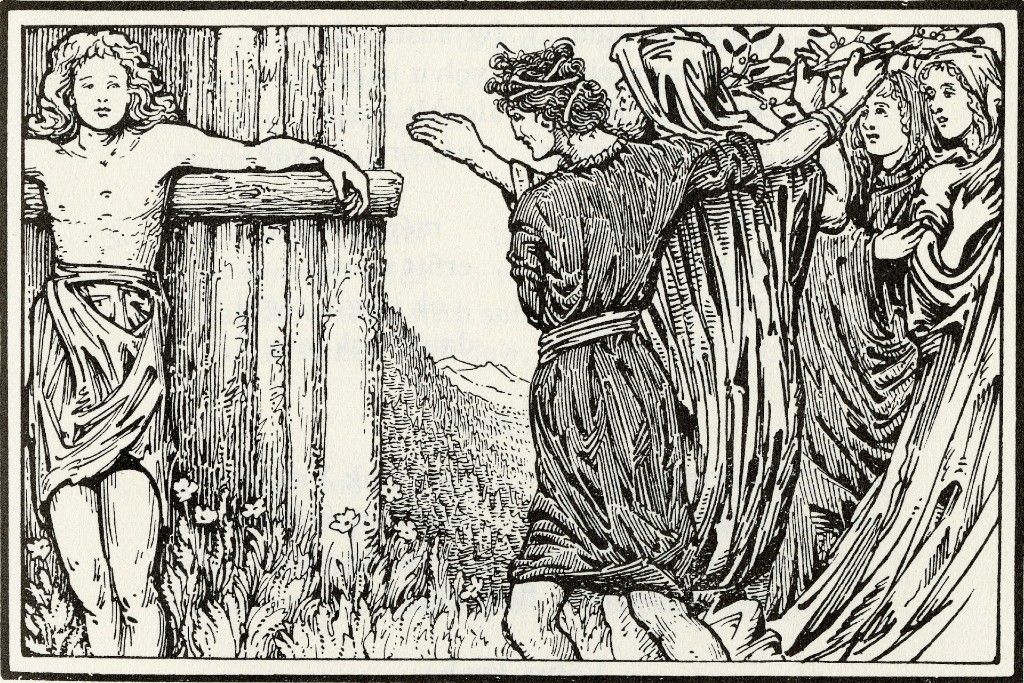
At the gathering, Baldr’s brother Höðr stands outside the circle.
In Snorri’s account, Höðr is blind. He cannot participate because he cannot see where Baldr is standing and has no weapon to throw. Loki approaches him and asks why he is not joining the others in honoring Baldr.
Höðr explains his limitations. Loki offers him the mistletoe and promises to guide his aim.
Höðr throws.
The mistletoe passes through Baldr, who falls dead before the assembled gods.
The Prose Edda calls the event the greatest misfortune ever to befall gods or human beings. The gods are initially unable to speak or act. They look at one another, knowing who has caused the deed, but the gathering is held in a place of sanctuary where immediate vengeance cannot lawfully be taken.
Only after the first shock passes do they begin to weep. Odin suffers most because he understands the full consequences. Baldr’s death is not an isolated family tragedy. It is the beginning of the sequence that will end with the destruction of the gods. :contentReference[oaicite:7]{index=7}
Höðr physically throws the weapon, but Loki arranges the killing. He finds the mistletoe, places it in Höðr’s hand, aims the blind god toward his brother, and encourages him to participate.
The story therefore divides responsibility between the hand that acts and the intelligence that makes the action possible. Höðr becomes the killer, but Loki is the architect of the crime.
The Vengeance of Váli
Baldr’s death requires vengeance under the heroic and familial values reflected in Norse literature.
According to Völuspá and Baldrs draumar, Odin fathers a son named Váli with the woman Rindr. Váli grows with supernatural speed. Before washing his hands or combing his hair, he kills Höðr and sends Baldr’s slayer to the funeral fire.
The vengeance is morally complicated. Höðr has killed Baldr, but he acted without understanding Loki’s plan. He is both the instrument of murder and another victim of Loki’s manipulation.
The later vision of the restored world adds another dimension. After Ragnarök, Baldr and Höðr return from Hel and live together in peace. The brothers who were divided by deception are eventually reconciled in the renewed world. :contentReference[oaicite:8]{index=8}
Baldr’s Funeral
The gods carry Baldr’s body to the sea and place it aboard his ship, Hringhorni, the greatest of all ships. They intend to transform the vessel into his funeral pyre, but even the gods cannot push it into the water.
They summon the giantess Hyrrokkin from Jötunheim. She arrives riding a wolf with a serpent for a bridle. With a single push, she launches the enormous ship so violently that the ground shakes and fire bursts from the rollers beneath it.
When Baldr’s wife Nanna sees his body placed upon the ship, her heart breaks and she dies. Her body is laid beside her husband’s on the pyre.
The funeral becomes a gathering of gods, goddesses, giants, valkyries, animals, and supernatural beings. Odin places his ring Draupnir upon the pyre. Baldr’s horse is burned with its equipment, while Thor consecrates the funeral fire with his hammer Mjölnir.
The scene demonstrates Baldr’s importance by showing the entire mythic world gathering around his death. His loss is not restricted to his household. It is a wound affecting the cosmic order itself. :contentReference[oaicite:9]{index=9}
Hermóðr’s Journey to Hel
Frigg refuses to surrender hope. She asks whether anyone will ride to Hel and offer a ransom for Baldr’s release. Hermóðr, another son of Odin, volunteers.
Mounted on Sleipnir, Hermóðr rides for nine nights through dark valleys until he reaches the bridge over the river Gjöll. The bridge’s guardian observes that Baldr has already crossed and directs Hermóðr farther downward and northward.
Hermóðr eventually leaps over the gate of Hel and finds Baldr seated in a place of honor. Baldr is not being tortured. Norse Hel is not identical to the Christian Hell; it is primarily a destination for many of those who die outside battle.
Hermóðr asks Hel, Loki’s daughter and the ruler of the dead, to release Baldr. Hel agrees to a test. If every living and dead thing in the world weeps for Baldr, she will allow him to return. If even one being refuses, he must remain.
Baldr gives Hermóðr the ring Draupnir to return to Odin as proof of their meeting. Nanna also sends gifts back to Frigg and other goddesses. :contentReference[oaicite:10]{index=10}
The Weeping of the World
Messengers travel throughout the worlds asking everything to mourn Baldr.
Humans, animals, earth, stones, trees, plants, and metals weep. Snorri connects the tears of seemingly lifeless objects with the moisture that appears when frozen things warm and begin to thaw.
The mission appears successful until the messengers enter a cave and find a giantess named Thökk.
They ask her to weep so that Baldr may leave Hel. She refuses. She declares that she did not love Baldr, whether living or dead, and that Hel should keep what she possesses.
Because one being will not mourn, Baldr remains among the dead.
Snorri states that people believe Thökk was Loki in disguise. If so, Loki has attacked Baldr twice. First he causes the death. Then, when the entire world is prepared to reverse it, he ensures that the death becomes permanent. :contentReference[oaicite:11]{index=11}
The episode also explains why Baldr cannot return before Ragnarök. His absence is not caused by Hel’s cruelty alone. It is secured by a deliberate refusal to participate in universal grief.
Loki’s Admission
The poetic source Lokasenna provides further evidence connecting Loki with Baldr’s fate.
In the poem, Loki enters a feast hosted by the sea-being Ægir and begins insulting the assembled gods and goddesses. He accuses them of cowardice, infidelity, dishonor, and hypocrisy. The exchange reveals a divine community already filled with resentment and buried scandal.
When Frigg challenges him, Loki claims responsibility for the fact that she will never again see Baldr ride home to the hall.
The statement does not describe the mistletoe plot in detail, but it directly associates Loki with Baldr’s continuing absence. It may refer to the killing itself, the refusal of Thökk to weep, or both. :contentReference[oaicite:12]{index=12}
Lokasenna is important because it shows that Loki’s connection to Baldr’s death was not created entirely by Snorri’s prose retelling. The poetic tradition already knew Loki as responsible for Frigg’s loss, even though the precise narrative relationships among the surviving sources remain uncertain.
The Capture and Punishment of Loki
After Baldr’s death and failed release, Loki flees from the gods.
He builds a house on a mountain with four doors so that he can watch for pursuers from every direction. During the day, he transforms himself into a salmon and hides beneath a waterfall.
While considering how the gods might capture him, Loki invents a fishing net. When he realizes that the gods are approaching, he throws the net into the fire and leaps into the river.
The wise Kvasir sees the pattern left by the burned cords and understands what Loki has made. The gods construct another net and drag it through the water. Loki attempts to escape by jumping over it, but Thor catches him.
The gods take Loki to a cave and bind him across three stones. In Snorri’s account, one of Loki’s sons is transformed into a wolf and kills his brother. The dead son’s entrails are then used to bind Loki, becoming iron-hard around his body.
The goddess Skaði fastens a venomous serpent above him. Poison drips toward Loki’s face, but his faithful wife Sigyn stands beside him holding a basin. Whenever the basin fills, she must turn away to empty it. During those moments, the venom strikes Loki, causing him to writhe so violently that the earth shakes.
There Loki remains until Ragnarök. :contentReference[oaicite:13]{index=13}
Baldr’s Death and Ragnarök
Baldr’s death is the first irreversible break in the order of Asgard.
Before it, the gods experience danger but usually restore what has been threatened. They recover stolen treasures, rebuild damaged walls, defeat giants, and escape seemingly impossible situations. Loki often assists in those recoveries.
Baldr cannot be recovered.
Loki’s binding does not eliminate the threat. It postpones the final confrontation. When the bonds break at Ragnarök, Loki joins the enemies of the gods and sails toward the battlefield with the forces of destruction. He and Heimdallr kill one another during the final battle. :contentReference[oaicite:14]{index=14}
The death of Baldr therefore marks Loki’s transition from an internal danger to an open enemy. The clever outsider who once traveled beside Thor and Odin becomes the leader of the powers attacking Asgard.
Baldr’s Return
Norse mythology does not end with destruction.
After Ragnarök, the earth rises green from the sea. Fields produce crops without being planted, and some of the surviving gods gather where Asgard once stood.
Baldr and Höðr return together from Hel. They sit with the other survivors, remember the former world, and recover objects belonging to the gods of the earlier age.
Their return resolves the tragedy in a way that could not occur before Ragnarök. Baldr and the brother who killed him no longer stand as victim and avenger. They inhabit a world in which the old cycle of feud, deception, and retaliation has ended.
Baldr’s restoration is therefore not merely a personal resurrection. It is evidence that the renewed world will differ from the world destroyed by violence. :contentReference[oaicite:15]{index=15}
The Alternative Story of Saxo Grammaticus
A very different version appears in Gesta Danorum, or The History of the Danes, written by the Danish historian Saxo Grammaticus around the end of the twelfth century.
Saxo transforms the gods into legendary or semi-divine rulers and warriors. His Balderus and Hotherus are rivals for the woman Nanna. Hotherus is not a helpless blind god but a talented human hero, musician, athlete, and warrior. Balderus desires Nanna and seeks to eliminate his rival.
The conflict becomes a military and romantic struggle. Hotherus eventually acquires a supernatural weapon capable of injuring Balderus and kills him. Loki plays no significant role in the death. :contentReference[oaicite:16]{index=16}
Saxo’s account demonstrates that the Baldr tradition circulated in more than one form. The Icelandic Eddic version emphasizes innocence, betrayal, fate, and cosmic disaster. The Danish version presents a heroic rivalry involving love, warfare, and magical weapons.
Neither text should automatically be treated as a complete record of a single original myth. Both were written by Christian authors preserving and reshaping older Scandinavian traditions for different literary purposes.
The Meaning of Baldr’s Death
The story has often been interpreted as a myth about seasonal change, the death of vegetation, solar decline, ritual sacrifice, or conflict between opposing divine powers. Such interpretations may illuminate parts of the narrative, but the surviving sources do not provide a simple explanation of Baldr as the summer sun killed by winter.
Within the texts themselves, several themes are clearer.
The first is the inevitability of fate. Odin foresees the disaster, Frigg attempts to prevent it, and the gods surround Baldr with supernatural protection. Every precaution fails because one overlooked weakness remains.
The second is the danger of misplaced confidence. Once Baldr appears invulnerable, the gods convert his protection into a game. They repeatedly perform the violent act that Loki eventually makes real.
The third is indirect responsibility. Loki does not personally throw the weapon, but he creates the conditions under which Höðr does so. Intelligence without moral restraint becomes more dangerous than physical strength.
The fourth is the destructive power of exclusion. Höðr stands outside the circle because of his blindness. Loki exploits his desire to participate, turning an apparent act of fellowship into fratricide.
Finally, the story concerns grief and the refusal of grief. The entire world is willing to mourn Baldr except one concealed figure. Loki’s final victory is achieved not through a weapon but through his refusal to acknowledge that Baldr’s life had value.
Legacy
The death of Baldr remains one of the defining stories of Norse mythology because it explains both the fall of Loki and the vulnerability of the gods.
The Æsir are powerful, but they are not immortal in an absolute sense. They can be deceived, wounded, killed, and defeated. Their knowledge of Ragnarök does not enable them to escape it.
Baldr represents the best qualities of the divine world, yet those qualities cannot save him. Loki represents intelligence separated from loyalty and responsibility. Höðr represents action without knowledge. Frigg represents love attempting to protect what it cannot permanently preserve. Odin represents wisdom burdened by the awareness of an unavoidable future.
The murder begins with something almost weightless: a young piece of mistletoe that no one considered dangerous.
From that overlooked branch comes the death of the most beloved god, the imprisonment of Loki, the division of the divine order, and eventually the end of the world.
Yet Baldr’s story also extends beyond Ragnarök. He returns after the old world has burned, reconciled with Höðr and prepared to inhabit a renewed creation. Loki’s deception brings about disaster, but it does not possess the final word.
Baldr’s death begins the fall of the gods. His return announces that something may still exist after their ending.