Odin's Sacrifice at Yggdrasil
The Allfather hangs from the world-tree and wins the secret of the runes.
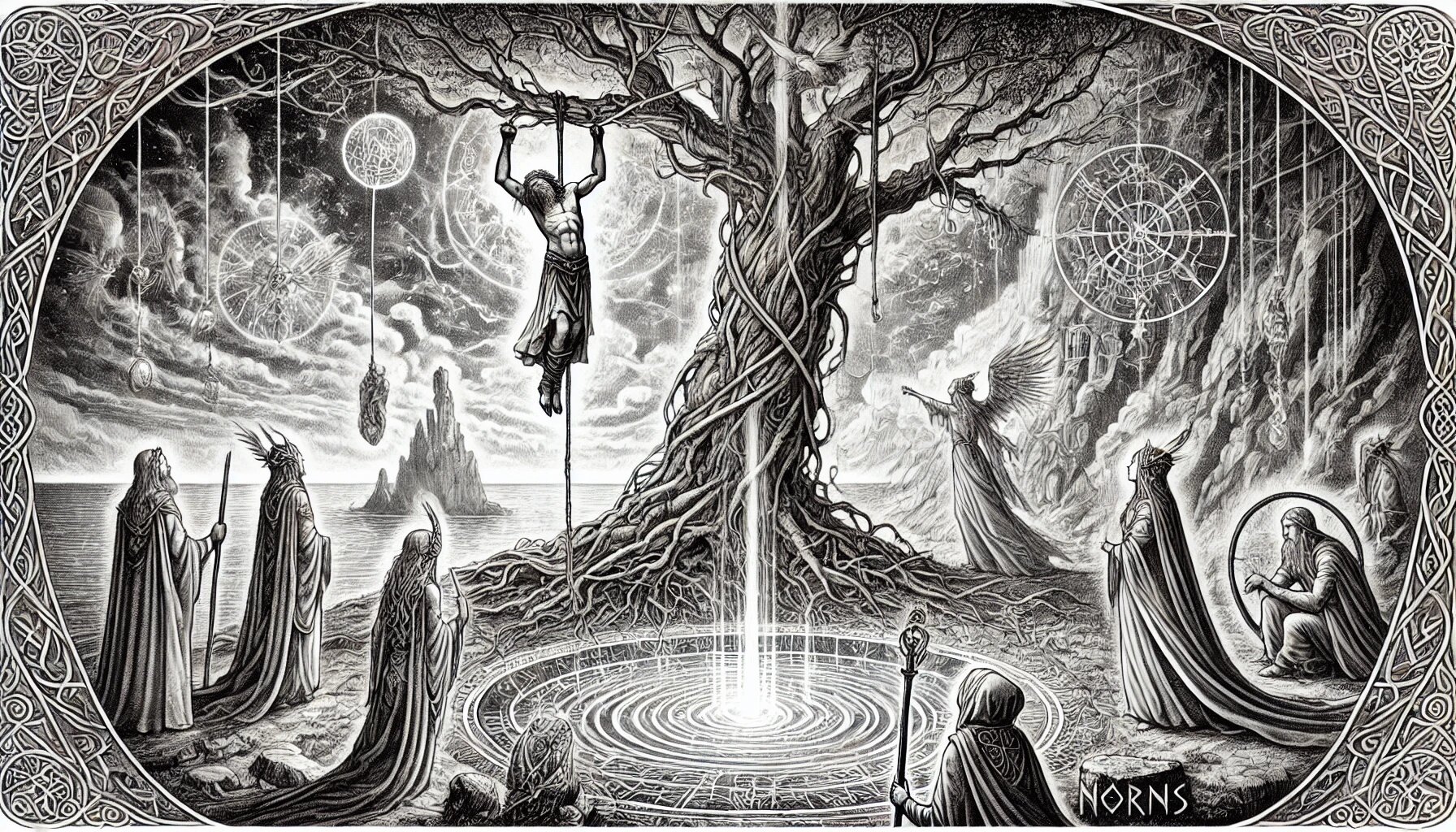
Nine nights. No food. No water. A spear through his own body, and the wind moving through a tree that held up the nine worlds. That's the scene at the center of one of the strangest stories in Norse mythology: a god hanging himself, wounding himself, giving himself to himself, just to learn something no one else knew how to teach him.
Most cultures have myths about gods who create knowledge and hand it down. The Norse version is different. Odin doesn't invent the runes. He doesn't receive them as a gift, either. He tears them out of the universe through an act of suffering that reads more like a shamanic ordeal than a divine decree. It's one of the oldest and strangest ideas in the entire mythology, and it says a great deal about how the Norse understood wisdom, sacrifice, and what it actually costs to know something true.
The Tree at the Center of Everything
To understand the sacrifice, you have to understand the tree.
Yggdrasil was an ash tree, though "tree" undersells it. In the cosmology described in the Poetic Edda and later expanded by Snorri Sturluson in the Prose Edda, Yggdrasil was the structure holding the nine worlds together. Its branches stretched over the heavens. Its roots reached into three different wells, each one tied to a different kind of knowledge or fate. One root touched Asgard, home of the gods. Another reached into Jotunheim, land of the giants, where the Well of Mimir sat, guarded by a being whose name meant "memory." A third root sank into Niflheim, the cold and misty underworld, near the well called Hvergelmir, where a serpent named Nidhogg gnawed endlessly at the roots.
The tree wasn't peaceful. A squirrel named Ratatoskr ran up and down its trunk carrying insults between an eagle at the top and Nidhogg at the bottom. Four stags grazed on its branches. It was alive, threatened, and constantly under strain, much like the cosmos it supported. Yggdrasil's name itself is worth pausing on. Scholars generally translate it as "Odin's horse" or "the horse of the terrible one," Ygg being one of Odin's many names, and a horse being a common Norse kenning for a gallows. That reading only makes sense once you know what Odin actually did there.
A God Who Already Knew Too Much and Still Not Enough
Odin wasn't a god who sat comfortably on knowledge he already had. That restlessness is part of what makes him different from most of the other gods in the Norse pantheon. Thor solved problems with strength. Odin solved them by hunting down information wherever it happened to be, no matter what it cost him.
He'd already given up an eye at Mimir's well for a single drink of water that granted wisdom. He wandered the nine worlds in disguise, testing people, gathering secrets, trading knowledge like currency. He kept two ravens, Huginn and Muninn, "thought" and "memory," who flew across the world each day and returned to whisper everything they'd seen into his ear. Even with all that, something was missing. The runes.
Runes in Norse tradition weren't simply an alphabet. They were treated as a form of power in their own right, tied to magic, prophecy, and the underlying structure of fate itself. To know the runes wasn't to know how to write. It was to understand the forces that shaped the world before language ever touched them. That kind of knowledge doesn't come from asking nicely. It has to be taken, and in Odin's case, taken from himself.
The Ordeal
The primary source for the sacrifice comes from the Hávamál, a collection of verses attributed to Odin himself, found in the Poetic Edda. In it, Odin describes what happened in his own voice, and the language is blunt in a way that still lands centuries later.
He says he hung on the windswept tree for nine full nights, wounded by a spear, given to Odin, himself to himself. He hung on that tree that no one knows where its roots run. No one brought him bread. No one brought him a drinking horn. He looked down, took up the runes, screaming, and fell back from there.
Read that again slowly, because it's doing a lot of work in very few lines. Odin hangs himself on the tree. He wounds himself with his own spear, the weapon he's associated with throughout the mythology. He offers himself as a sacrifice to himself, which is about as strange a theological statement as exists anywhere in world mythology. There's no other god receiving this offering. There's no altar, no priest, no external power being appeased. Odin is both the one making the sacrifice and the one the sacrifice is made to.
Nine nights was not a random number to the Norse. Nine shows up constantly in this mythology: nine worlds held by Yggdrasil, nine nights Odin spent with the giantess Gunnlod to win the mead of poetry, nine mothers of the god Heimdall. It was a number tied to completion and to major transitions, the kind of number that shows up whenever something is about to change permanently.
No food, no water, wounded, hanging by his own weight, staring down into the dark below the tree where the well and the roots disappeared into unknown territory. That's the setting. And at the end of it, after nine nights of nothing, Odin looked down and the runes appeared to him. He didn't calmly pick them up like tools laid out on a table. He screamed as he took them. The verse makes that scream part of the moment of acquisition, not separate from it. The knowledge and the agony arrive together, inseparable.
Why Suffering Was the Price
This is where the myth starts to say something bigger than just one strange story about one god.
In a lot of mythological traditions, wisdom is handed down. A god teaches a hero. A prophet receives a revelation. Knowledge moves from someone who has it to someone who doesn't, usually through some act of grace or divine favor. Odin's story rejects that model completely. There's no teacher here. There's no favor being granted. Odin has to become, briefly, something close to dead, stripped of comfort and sustenance, before the runes will show themselves to him at all.
That fits with a broader pattern in Norse belief around sacrifice, where giving something up, sometimes something enormous, was often the price for gaining anything of real value. Odin gave an eye for wisdom at Mimir's well. He nearly gave his life for the mead of poetry, seducing and abandoning Gunnlod to get it. And on Yggdrasil, he gave his body, his comfort, and very nearly his existence, hanging between life and death, in order to reach knowledge that apparently could not be reached any other way.
There's also a resemblance here to shamanic traditions found across many cultures, including among the Sami people who lived alongside the Norse in Scandinavia. Shamanic initiation in a lot of these traditions involves a symbolic death, often through fasting, isolation, or physical ordeal, followed by a return with new knowledge or spiritual power. Some scholars have pointed to this parallel as evidence that Odin's sacrifice reflects older shamanic practices absorbed into Norse religious thought, though how directly connected the two traditions actually are remains debated. What's not really in dispute is that Odin's ordeal on Yggdrasil follows the same basic shape: isolation, suffering, symbolic death, and a return carrying something the seeker didn't have before.
What the Runes Actually Gave Him
Once Odin claimed the runes, he didn't just walk away with an alphabet. According to the Hávamál, he learned eighteen charms alongside the runic knowledge itself, spells with specific practical uses. Some could calm the sea during a storm. Some could blunt an enemy's blade in battle. Some could heal wounds or extinguish fire. Others dealt with love, with binding an opponent's mind, with speaking to the dead. This wasn't abstract or purely symbolic wisdom. It was functional power, the kind that could be used to shape events in the physical world.
That detail matters because it tells you what the Norse actually believed knowledge was for. It wasn't contemplation for its own sake. It was a tool, and a dangerous one, worth almost anything to acquire. Odin's sacrifice wasn't a philosophical exercise. It was closer to theft, or maybe extraction, of something the universe didn't hand out freely.
Odin as the Wounded King of the Gods
There's something worth sitting with in the fact that the chief god of the Norse pantheon, the ruler of Asgard, the one who would one day lead the gods into their final battle at Ragnarok, is defined so heavily by wounds he chose for himself. He's not a god of untouched power. He's missing an eye. He hung himself on a tree and stabbed himself with his own spear. He's constantly wandering, testing, sacrificing, trading pieces of himself for pieces of understanding.
That's a very different picture of divine authority than you get in a lot of other mythologies, where the chief god tends to rule through strength or unquestioned right. Odin rules, in part, because he was willing to suffer more than anyone else was willing to suffer, to know more than anyone else knew. The Norse seem to have believed that real power and real wisdom weren't separate things you could pursue independently. They were bound together, and the binding always seemed to run through pain.
The Sacrifice's Place in the Larger Mythology
The story of Odin on Yggdrasil doesn't sit in isolation. It connects directly to the well at Mimir, where Odin traded his eye for a drink of wisdom-granting water, and it echoes forward into the myth of the mead of poetry, where Odin transforms into a serpent, seduces a giantess, and steals a magical drink capable of turning anyone who tastes it into a poet or a scholar. Taken together, these three stories build a portrait of a god whose entire character is organized around the pursuit of knowledge at almost any cost, physical, moral, or otherwise.
They also tie into the larger fate of the Norse cosmos itself. Odin's endless search for wisdom is partly driven by his awareness of Ragnarok, the foretold destruction of the gods and the world. He gathers knowledge because he's trying to understand, delay, or prepare for an ending he already knows is coming. The runes, the mead, the eye at Mimir's well, all of it feeds into a god trying to outthink a doom he can't actually avoid.
A Myth That Still Unsettles
What makes the story of Odin's sacrifice endure isn't really the plot. It's the strangeness of the image itself. A god hanging on a tree, wounded by his own weapon, giving himself to himself, screaming as knowledge arrives. There's no comfort in it, no easy moral, no clean resolution where wisdom shows up gently and everyone benefits without cost.
Instead there's a nine-night ordeal, a hunger for something that can't be reached any other way, and a god willing to nearly die to get it. It's a myth about the price of understanding, told by a culture that seemed to believe wisdom was never really free, no matter who you happened to be.