
Persephone and the Seasons
Pomegranate seeds bind Persephone to the underworld and explain the grief of winter.
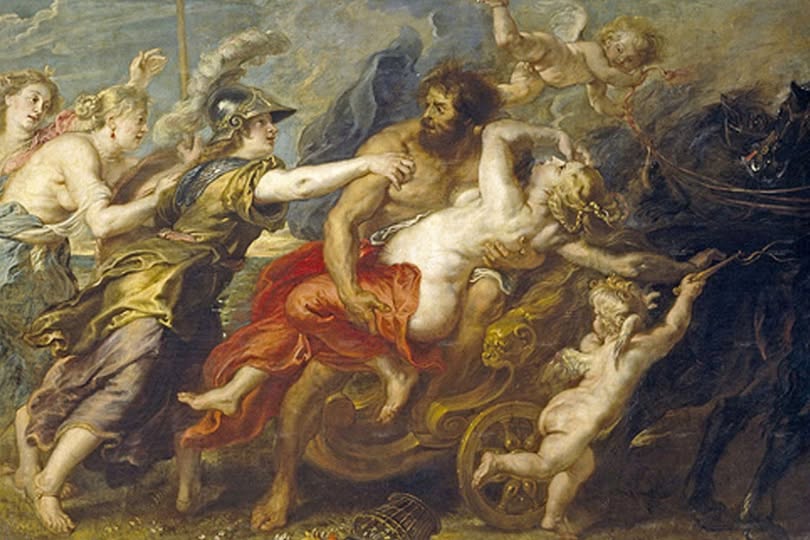
A field of flowers, a crack opening in the earth, and a girl pulled underground by a god she'd never met. That single moment, according to the Greeks, is why the world has winter. Persephone's story isn't really about death, even though it takes place partly in the underworld and involves the god who rules it. It's about a mother's grief, a bargain struck between gods who didn't much care what a young woman actually wanted, and the strange compromise that followed, one that still shapes the way we think about the changing seasons today.
The myth survives in its fullest early form in the Homeric Hymn to Demeter, likely composed sometime in the seventh century BCE, though the core story was almost certainly much older, passed down orally long before anyone wrote it down. It's one of the richer myths in the Greek tradition, not just because of what happens, but because of how directly it ties a personal, painful story to something as universal as the turning of the year.
A Daughter in a Field of Flowers
Persephone was the daughter of Demeter, goddess of the harvest, agriculture, and the fertility of the earth, and Zeus, king of the gods. Some later traditions call her Kore, simply "the maiden," in her earlier years, before her time in the underworld gave her a separate identity as its queen.
The Hymn opens with Persephone gathering flowers in a meadow alongside a group of companions, daughters of Okeanos according to the text, enjoying an ordinary and peaceful day. She notices an unusual flower, a narcissus, described in the Hymn as remarkably beautiful, grown specifically by Gaia, the earth itself, at the request of Zeus. It's a detail worth pausing on. The flower that lures Persephone away from her companions wasn't a random accident of nature. It was planted there deliberately, part of an arrangement between Zeus and Hades that Persephone herself had no part in and no knowledge of.
When Persephone reaches to pick the flower, the ground splits open beneath her. Hades, god of the underworld, emerges in his chariot and pulls her down into the earth before she can call out for help in any way that would let her mother or anyone else find her in time.
A Bargain Made Without Her
The abduction itself had been arranged in advance. According to the myth, Hades had asked Zeus for permission to take Persephone as his wife, and Zeus agreed, without informing Demeter and without asking Persephone what she wanted at all. It's one of the more uncomfortable details in Greek mythology, and ancient audiences seem to have understood it that way too. The Hymn doesn't dress up the abduction as romantic or consensual. Persephone is taken by force, against her will, screaming for her father and mother as Hades pulls her down into the earth, with Zeus fully aware of what was happening the entire time.
Demeter hears her daughter's cries from a distance but arrives too late to stop it. What follows is one of the more emotionally direct sequences in all of Greek myth. Demeter searches for her daughter for nine days, refusing food, refusing rest, carrying torches through the dark because she can't bring herself to stop looking even at night. Neither gods nor mortals can tell her clearly what happened, until Hecate, goddess associated with magic and the crossroads, and Helios, the sun god who sees everything that happens on earth, finally tell her the truth. Hades has taken Persephone, with Zeus's blessing, to be his wife in the underworld.
A Mother's Grief and a World Gone Cold
Demeter's response to this news is where the myth turns from a personal tragedy into something with consequences for the entire world.
Furious with Zeus and unwilling to return to Olympus, Demeter disguises herself as an old woman and wanders the earth. She eventually settles in the city of Eleusis, where she's taken in by the local royal family without anyone realizing who she truly is. She serves for a time as a nurse to the infant son of the king and queen, and in a lesser known part of the Hymn, she attempts to make the child immortal by holding him in fire each night, a process interrupted when his mother walks in and panics at the sight of her son in the flames. Demeter, offended and exposed, reveals her true divine identity and instructs the people of Eleusis to build her a temple, which becomes the setting for the Eleusinian Mysteries, one of the most important religious cult practices in the ancient Greek world.
But grief hadn't left Demeter, and neither had her anger. As goddess of the harvest and the fertility of the land, she withdraws her blessing from the earth entirely. Crops stop growing. Fields that should be full of grain sit barren. Livestock have nothing to graze on. Famine spreads across the human world, and with it, a serious problem for the gods themselves. Mortals can't perform sacrifices to the gods if they have no crops or livestock left to offer, and the gods depended on those offerings and on human worship to maintain their own honor and status.
Zeus eventually has to intervene, not out of concern for Demeter's feelings exactly, but because the situation has become untenable for gods and mortals alike. He sends messengers asking Demeter to return to Olympus and let the earth flourish again. She refuses every request, making clear that she won't relent until she sees her daughter again.
The Compromise, and the Trap
Zeus finally sends Hermes to the underworld to retrieve Persephone and reunite her with her mother. Hades, according to the Hymn, agrees to let her go, though the text is careful to note that before she leaves, he gives her a few seeds of pomegranate to eat.
This detail matters enormously in Greek myth. Eating food in the underworld created a binding connection to that realm. By eating even a small portion of pomegranate seeds, whether she understood the consequence at the time or not, Persephone tied herself permanently to the underworld, guaranteeing she would have to return there for part of every year going forward.
Some later versions of the myth frame this moment differently, suggesting Persephone had grown at least somewhat accustomed to her role as queen of the underworld by the time Hermes arrived, and that eating the seeds wasn't purely a trick played on an unwilling victim but something closer to a compromise she participated in, however reluctantly. The earliest Hymn leaves this more ambiguous, describing Hades giving her the seeds secretly, "so that she would not remain forever" with her mother, a phrasing that suggests calculation on his part regardless of how willing Persephone may or may not have become.
Mother and Daughter Reunited, With a Catch
When Persephone returns to Demeter, their reunion is one of genuine joy in the text, described with real warmth after the anguish of the search. But Demeter immediately asks whether her daughter ate anything while in the underworld, aware of exactly what that would mean.
Persephone confirms that she ate the pomegranate seeds, and the arrangement that follows becomes the origin point for the seasonal cycle itself. Zeus works out a compromise between Demeter and Hades. Persephone will spend part of each year in the underworld with Hades as its queen, and the rest of the year above ground with her mother. Different ancient sources give slightly different splits, with later traditions commonly settling on Persephone spending a third of the year, or sometimes half, below the earth.
During the months Persephone is with her mother, Demeter allows the earth to flourish, crops grow, and the world moves through spring, summer, and the fullness of harvest. When Persephone descends to the underworld each year to fulfill her side of the arrangement, Demeter's grief returns, and with it, the world grows cold and barren. Fields go still. Growth stops. That, according to the Greeks, is winter, not a natural cycle rooted in the tilt of the earth or the distance from the sun, but a mother's yearly mourning made visible across the land.
More Than a Seasons Myth
It would be easy to read this story as a simple explanation for winter and leave it there, but the myth carried far more weight in ancient Greek life than a seasonal metaphor alone. The Hymn to Demeter directly connects the story to the founding of the Eleusinian Mysteries, a set of secret religious rites practiced at Eleusis for well over a thousand years, among the longest continuously practiced religious traditions in the ancient world.
Initiates into the Mysteries were sworn to secrecy about exactly what happened during the rites themselves, and that secrecy was taken seriously enough that relatively little concrete detail survives about the actual ceremonies today. What is known suggests the Mysteries dealt heavily with themes of death, rebirth, and the promise of a better fate in the afterlife for those who had been properly initiated, themes that map directly onto Persephone's own yearly cycle of descent and return. Persephone wasn't just a mythological figure explaining crop cycles to the ancient Greeks. She became a symbol of hope for something beyond death itself, proof that descent into the underworld didn't have to be permanent, and that return and renewal were genuinely possible, even for someone taken against their will into the realm of the dead.
A Queen, Not Just a Victim
It's worth noting that Persephone's role expanded considerably beyond victim of abduction as her mythology developed further. In later stories and cult practice, she appears as a genuinely powerful queen of the underworld, capable of showing mercy, granting requests, and exercising real authority alongside Hades rather than simply existing as his prisoner. In the myth of Orpheus, for instance, it's Persephone who is moved by his grief and his music, and who convinces Hades to allow Eurydice a chance to return to the world of the living, a rare instance of the underworld's rules bending because of one figure's compassion.
That dual nature, maiden of spring and queen of the dead, gives Persephone a complexity that a lot of other figures in Greek mythology don't get to have. She's not purely a victim, and she's not purely a monarch of the underworld either. She's both, shifting between roles as reliably as the seasons themselves shift between growth and dormancy, carrying grief and renewal together in a single figure, exactly the way winter and spring depend on each other to make sense of the whole year.
Why This Story Still Lands
The myth of Persephone endures for reasons beyond its explanation of winter, though that explanation alone would probably be enough to keep it alive in cultural memory. It's a story about a mother's love pushed to its absolute limit, powerful enough to bring an entire world to a standstill until her child was returned. It's a story about a young woman taken from an ordinary life and given no say in the matter, who somehow becomes something more than a victim by the story's end. And it's a story that ties something as vast and impersonal as the changing of the seasons directly back to grief, love, and the complicated bargains made between people, and gods, who don't always agree on what's fair.
Every year, according to the ancient Greeks, the world goes cold because a mother is mourning her daughter's absence, and every spring, it warms again because that daughter has come home, if only for a while. It's a strange way to explain the weather. It's also one of the more honest myths about love the Greeks ever told.