
The Twelve Labors of Heracles
Atonement, impossible tasks, and the making of the best-known Greek heroic cycle.
Heracles didn't start out looking for glory. He started out trying to survive his own mind.
That's the part of the story people skip when they jump straight to lions and hydras. Before any of the labors, Hera — who had hated this half-mortal son of Zeus since before he was born — sent a fit of madness down on him. In that madness, Heracles killed his own wife, Megara, and their children. When the fog lifted and he understood what his hands had done, he didn't run from it. He went to the Oracle of Delphi and asked how a man atones for the unforgivable.
The answer: serve King Eurystheus of Mycenae for a set number of years, and do whatever the king demanded. Eurystheus, no fan of his famous cousin, decided to demand the impossible. Ten tasks turned into twelve once he disqualified two on technicalities. What followed is the most famous to-do list in Greek mythology — and, underneath the monsters, a pretty sharp piece of storytelling about what it costs to actually change.
First Labor: The Nemean Lion
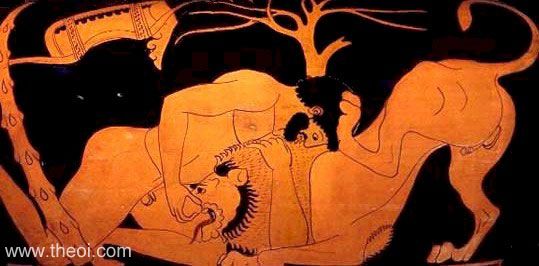
Eurystheus opened with a lion that couldn't be killed. Its hide turned aside bronze, iron, and stone — Heracles found that out the hard way when his arrows bounced off its ribs like pebbles off a shield.
So he cornered it instead. The lion's cave had two mouths; Heracles sealed one, walked in through the other, and beat the beast down with his bare hands in the dark. No sword got the job done. His grip did.
Skinning it turned out to be its own problem — nothing could cut hide that no weapon could pierce. Heracles finally used one of the lion's own claws. That pelt became his signature, the lion's head worn as a helmet, thrown over his shoulders like armor no one else could wear. Every later image of Heracles — statues, coins, vase paintings — puts that pelt on him. It's the first thing this story gives him, and he never takes it off again.
Second Labor: The Lernaean Hydra
A swamp-dwelling serpent with more heads than anyone had bothered to count, and a nasty trick: cut one off, and two grow back in its place.
Heracles brought his nephew Iolaus along, and this is where the labor stops being a monster story and starts being a strategy story. Every time Heracles lopped off a head, Iolaus pressed a burning torch to the stump before it could regenerate. Head by head, they worked their way down to the one skull that couldn't die at all — Heracles buried that one under a boulder and left it there, immortal and useless.
He dipped his arrows in the hydra's blood before he left. That poison follows him through the rest of the myth, right up to his own death by way of a centaur's revenge. Eurystheus, unimpressed that Heracles had help, refused to count this one toward the total.
Third Labor: The Ceryneian Hind
Not everything Eurystheus threw at him wanted to kill him. The hind was sacred to Artemis — golden-antlered, faster than any arrow, and the king's assignment amounted to: go desecrate a goddess's pet and see what happens.
Heracles chased it for a full year across Greece, through Thrace, into lands where snow doesn't melt. He finally caught it asleep and pinned it with a net rather than harm it. When Artemis found him carrying her deer away, he told her the truth — a king's order, not malice — and she let it go, more or less literally. He returned the hind to Eurystheus only long enough to satisfy the letter of the task, then set it free the moment the king came close enough to take it himself. Eurystheus wasn't fast enough. Heracles made sure everyone knew it.
Fourth Labor: The Erymanthian Boar
On the way to the boar's mountain, Heracles stopped to visit an old friend, the centaur Pholus, and that detour turned into a disaster nobody planned for. Wine meant for careful sipping got opened, the smell drew in a crowd of drunk centaurs, and a brawl broke out that Heracles hadn't come looking for. He fired his poisoned arrows to break it up. One grazed Chiron, the wisest of the centaurs and immortal — the wound still burned like nothing he'd felt before, and the pain became the reason Chiron eventually traded his immortality to free Prometheus from his chains.
The boar itself was almost an afterthought after that. Heracles drove it into deep snow, where it lost its footing, bound it, and carried it back alive. Eurystheus took one look at the thing and hid in a storage jar buried in the ground — the first time he does that, but not the last.
Fifth Labor: The Augean Stables
This was supposed to be humiliation dressed up as a chore. Clean out stables that hadn't seen a shovel in thirty years, home to more than a thousand immortal cattle, and do it alone, in a day.
Heracles didn't grab a shovel. He redirected two rivers — the Alpheus and the Peneus — straight through the stable walls and let the current do what no man could. It worked exactly as well as you'd expect a river to work. Eurystheus, furious that the trick had succeeded, refused to count it: Heracles had struck a deal for payment with King Augeas beforehand, so the labor was disqualified on a technicality rather than a failure.
Sixth Labor: The Stymphalian Birds
Bronze beaks, metal feathers they could launch like arrows, and a taste for human flesh — the Stymphalian birds had taken over a lake in Arcadia and made the surrounding farmland unlivable. The swamp itself wouldn't hold Heracles's weight, so brute force was off the table from the start.
Athena stepped in with a gift from Hephaestus: a bronze rattle loud enough to send the whole flock screaming into the air at once. Airborne, they were just birds. Heracles picked off as many as he could reach with his bow, and the rest scattered for good.
Seventh Labor: The Cretan Bull
The father of the Minotaur, loose on Crete and terrorizing the island. King Minos, who might have had every reason to want the thing gone, told Heracles to handle it himself rather than lending any help.
He did. Wrestled the bull into submission with his hands, hauled it back to Eurystheus, and then — in a decision that says a lot about how these labors kept generating their own sequels — let it go free once the king had seen it. The bull wandered until it ended up terrorizing the plain of Marathon, setting up trouble for a very different hero, Theseus, years later.
Eighth Labor: The Mares of Diomedes
Four horses that ate people. Diomedes, king of the Bistones in Thrace, fed them on the flesh of travelers unlucky enough to wash up on his shore, and some tellings have the mares breathing fire on top of that.
Heracles broke their chains and drove them toward the sea, leaving them in the care of his companion Abderus while he settled things with Diomedes directly. That trust turned out to be misplaced — the mares killed and ate Abderus while Heracles was gone. He answered in kind: fed Diomedes to his own horses, then founded a city, Abdera, beside the boy's grave. Once they'd eaten their master, the mares calmed enough to be led away.
Ninth Labor: The Belt of Hippolyta
Eurystheus's daughter wanted a trophy — the war belt of Hippolyta, queen of the Amazons, a gift to her from her father Ares. Heracles sailed for the Amazons' shores expecting, if the stories are believed, a fight. He got a negotiation instead. Hippolyta, taken with him, agreed to hand the belt over freely.
Then Hera intervened, same as always, disguising herself among the Amazons and convincing them that the strangers meant to kidnap their queen. The Amazons charged. Heracles, believing Hippolyta had set him up, killed her before he understood what had actually happened. He took the belt and sailed on, and the labor closes on a note the whole cycle keeps returning to: a goddess's grudge outliving every chance the hero has to get it right.
Tenth Labor: The Cattle of Geryon
Getting there took longer than the fight itself. Heracles crossed a scorching wasteland so miserable that he actually shot an arrow at the sun in frustration — and Helios, apparently charmed rather than offended, lent him the golden cup he used to sail across the sea each night.
Geryon himself was a giant with three bodies fused at the waist, guarded by a two-headed dog and a herdsman, both of whom Heracles dispatched before Geryon even reached the fight. One arrow through the giant's skull ended it. Driving the cattle home took months and included, in the Roman version of the tale, a run-in with the thief Cacus on the future site of Rome — a detour that gave the city one of its own founding legends, borrowed wholesale from a Greek hero passing through.
Eleventh Labor: The Apples of the Hesperides
By now Eurystheus had disqualified two labors and needed two replacements. This one asked Heracles to steal fruit from a garden at the edge of the known world, guarded by nymphs, a dragon, and — depending on the version — held up by Atlas himself.
Heracles found Atlas holding the sky on his shoulders and made him an offer: hold it a little longer, fetch three apples, and Heracles would take the burden back once he returned. Atlas agreed, got the apples, and then decided he liked being apple-free more than he'd expected — he offered to deliver them himself and leave Heracles stuck holding up the heavens permanently. Heracles played along just long enough to trick Atlas back into the position, on the pretext of adjusting his cloak, then walked off with the apples for good. It's one of the only labors Heracles wins with a lie instead of a lion.
Twelfth Labor: Cerberus
The last task and the hardest sell: walk into the underworld, take Hades's own guard dog, and bring him back to the world of the living. Before he could even attempt it, Heracles had to be initiated into the Eleusinian Mysteries just to earn safe passage below.
Hades set one condition — no weapons. Heracles wrestled the three-headed dog into submission with nothing but his hands and his strength, then carried it up through a cave mouth in the Peloponnese. Eurystheus took one look at Cerberus and, for the second time, dove into his buried storage jar. He begged Heracles to take the dog back to the underworld in exchange for finally ending the labors. Heracles agreed. Twelve tasks, ten years or more, and it ended with a king hiding in a jar from the cousin he'd tried to break.
What the Labors Were Actually For
Later Greek writers, especially the Stoics, read the labors as something closer to a map of the human mind than a monster hunt. The Nemean lion was reckless aggression. The hydra was pleasure that regenerates the moment you think you've cut it out. The Augean stables were the accumulated filth of a life left untended. None of that reading requires you to throw out the version with actual lions and actual rivers — the two sit on top of each other without much friction, which might be why the story has lasted this long.
What holds the whole cycle together isn't the monsters. It's the shape of the punishment. Heracles didn't earn his fame by being strong — Greek myth is full of strong men who accomplish nothing worth telling. He earned it by taking on an impossible sentence for an unforgivable act and refusing to either die trying or cut corners. Every labor could have killed him. A few of them — Chiron's wound, Hippolyta's death — left damage he couldn't undo even in victory. The story never pretends atonement is clean. It just keeps making him show up for the next one anyway.