Hypnos and Thanatos: Sleep and His Half-Brother Death
Twin sons of Nyx carry mortals from the waking world: one for a night, the other forever.
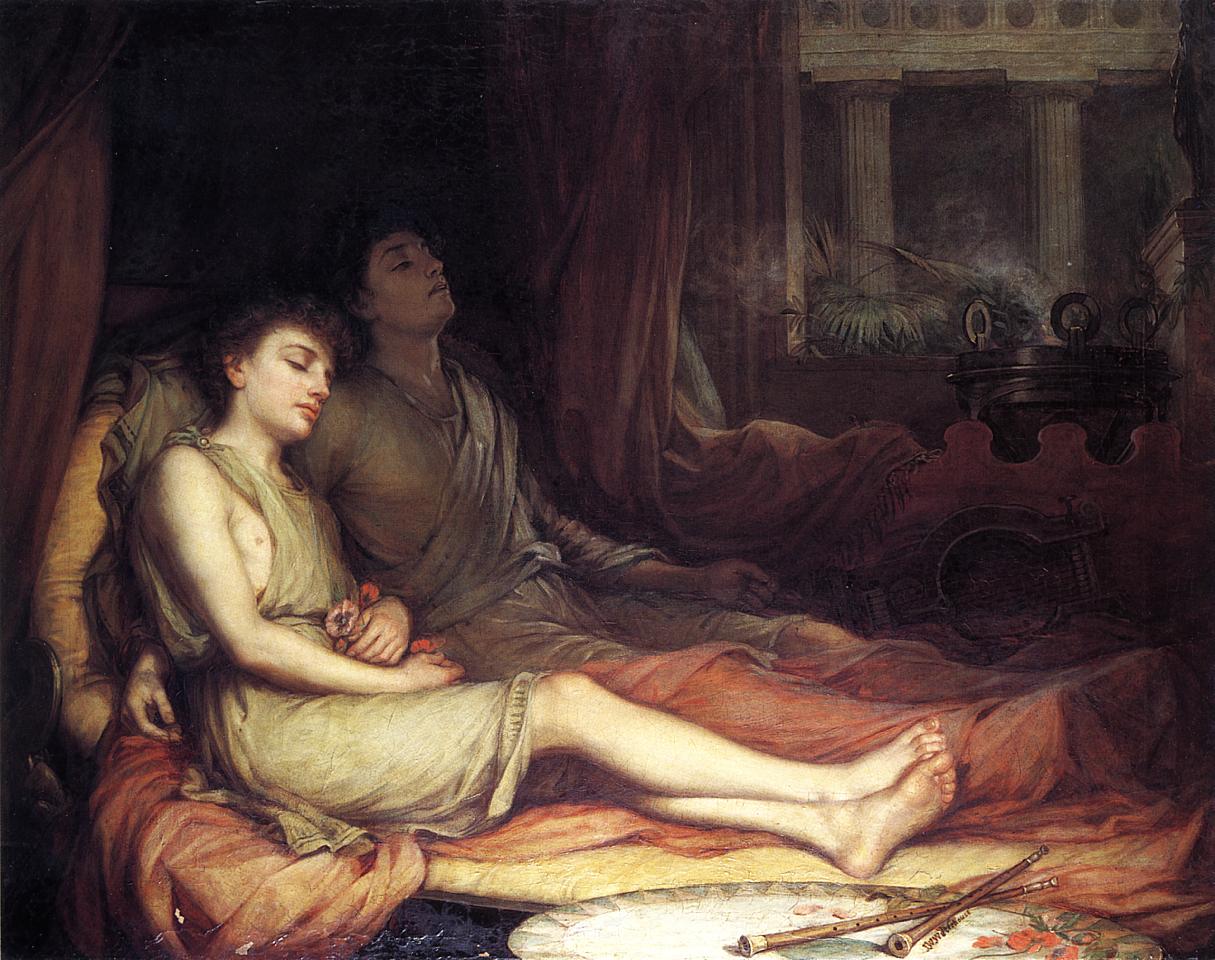
Somewhere beneath the earth, past the edge of the ordinary world, the Greeks imagined a cave where daylight never entered and no rooster ever crowed. Two brothers lived there together. One handed out rest, dreams, and a few hours of forgetting every single night. The other handed out something nobody got to give back. Together they were Hypnos and Thanatos, Sleep and Death, and the Greeks treated them not as enemies but as family, born from the same womb, doing quieter, gentler versions of the same job.
That detail alone tells you something about how the Greeks thought about death. It wasn't a monster to be defeated or a punishment to be feared in the way later traditions sometimes framed it. It was a brother of sleep. Close enough in appearance that ancient artists painted them as twins. Different enough that one could be reasoned with and the other could not.
Children of the Night
Hypnos and Thanatos were sons of Nyx, the primordial goddess of night, one of the oldest beings in Greek cosmology, older than most of the Olympians, older even than a lot of the Titans. Hesiod's Theogony, one of the earliest surviving sources on Greek myth, lists them together in a single breath among Nyx's children, born without a father, part of a whole family of dark, quiet forces that shaped human experience from the shadows.
Nyx's other children included Nemesis, goddess of retribution, Eris, goddess of strife, and the Moirai, the three Fates who measured out and cut the thread of every human life. It's a rough family to be raised in, if you can call it that, though Nyx herself was rarely described as cruel. She was simply vast, older than judgment, present at the edges of everything.
Hypnos and Thanatos lived together in a cave near the river Lethe, whose waters caused forgetting, somewhere at the edge of the underworld. Ovid describes the location later in the Metamorphoses, painting a place with no light, no sound, and no distinction between day and night, fitting for two gods whose whole purpose involved erasing the difference between waking and not waking at all. Poppies grew at the cave's entrance in some versions of the story, a detail that made its way straight into later art and even into modern associations between poppies and eternal sleep.
Hypnos, Gentle and Persuasive
Hypnos got the better reputation of the two, by a wide margin.
He was usually shown as a young man, sometimes with wings at his temples, sometimes carrying a horn of sleep-inducing poppy juice, occasionally holding a branch that dripped water from the river Lethe onto the eyes of anyone he wanted to put under. He wasn't feared. If anything, he was welcomed. A visit from Hypnos meant rest, dreams, and a temporary break from whatever was going wrong in a person's waking life.
Homer gives Hypnos a fairly significant supporting role in the Iliad. In one memorable episode, Hera needs Zeus distracted and asleep so the Greeks can gain ground in the Trojan War without his interference. She turns to Hypnos for help, and he agrees, but not without hesitation. He reminds Hera that he'd tried something similar once before at her request, putting Zeus to sleep so she could move against Heracles, and Zeus had woken up furious enough that Hypnos barely escaped punishment by hiding with his mother Nyx, whom even Zeus was unwilling to provoke. Hypnos only agrees to help again once Hera offers him something in exchange, a wife among the younger Graces, showing that even gentle gods knew how to negotiate.
That story matters because it shows Hypnos as more than a passive force. He had power over Zeus himself, arguably the only being in Greek myth who could reliably overwhelm the king of the gods, if only for a few hours. Sleep, in other words, was treated as something even the most powerful beings couldn't fully resist. Not through violence, but through quiet, unavoidable persuasion.
Hypnos also had an enormous family of his own tied to dreams. His sons, sometimes numbering in the thousands according to Ovid, were the Oneiroi, spirits responsible for the dreams that visited sleeping mortals. Three were named specifically. Morpheus, who could take on human shapes and appear in dreams as specific people. Phobetor, who appeared as animals and was associated with nightmares. Phantasos, who took the form of inanimate objects, earth, water, stone, wood, giving dreams a strange, shifting quality. Through his children, Hypnos didn't just put people to sleep. He shaped what happened once they were under.
Thanatos, Quiet and Absolute
Thanatos, by contrast, carried none of that warmth.
He was usually depicted as a winged figure as well, often shown alongside his brother, sometimes holding a sword or an extinguished torch, a symbol that carried straight through into later Roman and even modern funerary art. Unlike a lot of death figures in other mythologies, Thanatos wasn't typically shown as monstrous or grotesque. He was simply cold, inevitable, and largely indifferent. He didn't hate humans. He didn't enjoy his work. He came, did what needed doing, and left.
Hesiod describes him bluntly as hateful even to the gods, a rare descriptor for a figure who otherwise doesn't get much personality in early sources. That's a telling detail. The Greeks didn't spend a lot of time humanizing Thanatos the way they did with Hypnos. He shows up, performs his function, and largely stays out of the spotlight, which fits the way most cultures tend to talk about death itself. Sleep gets poetry. Death gets silence.
One of the clearest appearances of Thanatos in surviving myth comes from the story of Alcestis, dramatized by Euripides in his play of the same name. King Admetus is fated to die, but the Fates allow him a loophole. If someone else agrees to die in his place, he gets to live. His wife Alcestis volunteers. When the time comes for her to be taken, Thanatos himself arrives to collect her, and the play treats his arrival with a kind of formal, businesslike dread, a debt being collected rather than a punishment being delivered.
Heracles, as it happens, is present at the house when Thanatos comes for Alcestis, and in a scene that shows just how differently Death could be treated depending on who was facing him, Heracles physically wrestles Thanatos and forces him to give Alcestis back. It's one of the few myths where Death loses an argument, and even then, it takes the strength of one of the greatest heroes in Greek mythology to manage it. Thanatos isn't cruel in the story. He's simply overpowered, which is arguably a more unsettling idea than cruelty would have been. Death, in this telling, isn't malicious. It's just usually stronger than anyone standing in its way.
Sisyphus and the God Who Got Chained
The most famous story involving Thanatos directly is the myth of Sisyphus, a king known across Greek tradition for being clever to the point of arrogance.
When Thanatos arrives to take Sisyphus to the underworld, Sisyphus tricks him. Accounts vary on the exact method. In some versions, Sisyphus asks Thanatos to demonstrate how a set of chains work, supposedly out of curiosity, and once Thanatos puts them on to show him, Sisyphus locks him in place and simply leaves him there. With Death bound and unable to move, no one on earth could die. Ares, who depended on death to make war meaningful, eventually grew frustrated with a battlefield where nobody stayed down, and freed Thanatos himself so the natural order could resume.
Sisyphus's punishment for this trick, along with several other acts of deceit against the gods, became one of the most famous images in the underworld itself. He was condemned to roll a boulder up a hill forever, watching it roll back down each time he neared the top, an endless, pointless labor that has since become shorthand across Western culture for hopeless effort.
The story is worth pausing on because it's one of the only myths where a mortal manages to outsmart Death entirely, even briefly, and the consequence isn't framed as heroic. It's framed as a violation of the natural order serious enough to earn one of the worst punishments in the entire underworld. Death, however grim, was treated as necessary. Cheating it wasn't clever in the way the Greeks usually rewarded cleverness. It was closer to an offense against the structure of the world itself.
Twins in Art, Opposites in Function
Greek and Roman artists loved putting Hypnos and Thanatos side by side, often nearly identical in appearance, sometimes shown lifting the body of a fallen warrior together, most famously Sarpedon, a son of Zeus killed at Troy. In these images, Hypnos and Thanatos carry Sarpedon's body gently between them, wings spread, expressions calm, an image that shows up on painted pottery going back centuries.
The choice to make them look alike wasn't an accident. Death, in Greek imagination, wasn't always framed as sleep's opposite. It was sleep's more permanent cousin, the family resemblance impossible to miss once you knew to look for it. Sleep offered temporary release from consciousness, worry, and pain. Death offered the same thing, minus the temporary part. The Greeks weren't shy about drawing that line directly. Homer, in fact, repeatedly describes death in the Iliad using language borrowed straight from sleep, warriors falling into "brazen sleep" or having their eyes closed by death in language nearly identical to phrases used elsewhere for ordinary rest.
What the Pairing Says About Greek Thought
Putting Hypnos and Thanatos together as brothers wasn't just a tidy mythological detail. It reflects something the Greeks seemed to believe fairly deeply, that death and sleep were points on the same spectrum rather than opposites facing off against each other. Both involved a kind of departure from waking awareness. Both were largely outside human control. Both, in their own ways, offered relief, whether from a hard day or from life itself.
That's a very different emotional register than the one found in traditions where death is treated primarily as an enemy to be fought, feared, or defeated through faith or heroism. The Greeks certainly feared death, and their heroes went to considerable lengths to avoid it or delay it. But the mythology itself never framed Thanatos as evil. He was simply doing what needed to be done, in the same quiet, unglamorous way his brother put mortals to sleep every night. One brother gave people a break. The other made the break permanent. Neither one, in the end, was really the villain of the story. They were just doing the family business.