
Romulus, Remus, and the She-Wolf
Twin sons of Mars, a river rescue, a she-wolf, and the violent foundation of Rome.
Every civilization tells a story about where it came from. Rome's version involves twin brothers thrown into a river, a wolf that decided to nurse them instead of eating them, and a fight between the two survivors that ended with one of them dead and a city named after the other. It's a strange, violent way to explain a nation's origins, and the Romans knew it. They told the story anyway, over and over, on coins, in temples, and in the first great work of their own history, because the strangeness was part of the point.
The myth of Romulus and Remus isn't a gentle founding story. It's a story about survival against long odds, betrayal between brothers, and a city built on a foundation that included murder from its very first day. That combination, heroic and brutal in equal measure, tells you a great deal about how the Romans understood their own identity.
A Grandfather Overthrown
The story usually begins two generations before the twins are even born, in the city of Alba Longa, ruled by a king named Numitor. Numitor had a brother, Amulius, who wanted the throne for himself and got it through force, driving Numitor out and killing his sons to remove any rivals to the crown.
Amulius wasn't finished. Numitor's daughter, Rhea Silvia, was still alive, and any children she might have could grow up to challenge his rule someday. Amulius solved that problem by forcing Rhea Silvia to become a Vestal Virgin, a priestess of Vesta bound by a vow of celibacy. As long as she had no children, the succession problem disappeared.
It didn't work. According to the version of the story recorded by the Roman historian Livy in his history of Rome, and expanded further by later writers like Plutarch, Rhea Silvia became pregnant anyway, and claimed the god Mars himself was the father. Whether that claim was meant to be taken literally by later Roman audiences or understood as a convenient cover story is something ancient authors themselves debated. Livy, writing centuries after the supposed events, treats the divine parentage with a certain amount of distance, noting that Rhea Silvia may have said it was Mars, or may have simply believed it, or found it a more acceptable explanation than the alternative. Whatever the truth behind the claim, the result was the same. She gave birth to twin boys, Romulus and Remus.
Abandoned to the River
Amulius wasn't about to let two potential rivals grow up under his nose. He ordered the infants killed, and depending on the version, either had them thrown directly into the Tiber River or set adrift on it in a basket, a method of disposal that shows up in a number of ancient myths involving unwanted or threatening royal children.
The servant given the task, in most versions, couldn't quite bring himself to finish the job outright. He left the twins at the edge of the flooded river instead of drowning them directly, and the water carried the basket downstream until it came to rest near the base of the Palatine Hill, one of the seven hills that would eventually make up the city of Rome itself.
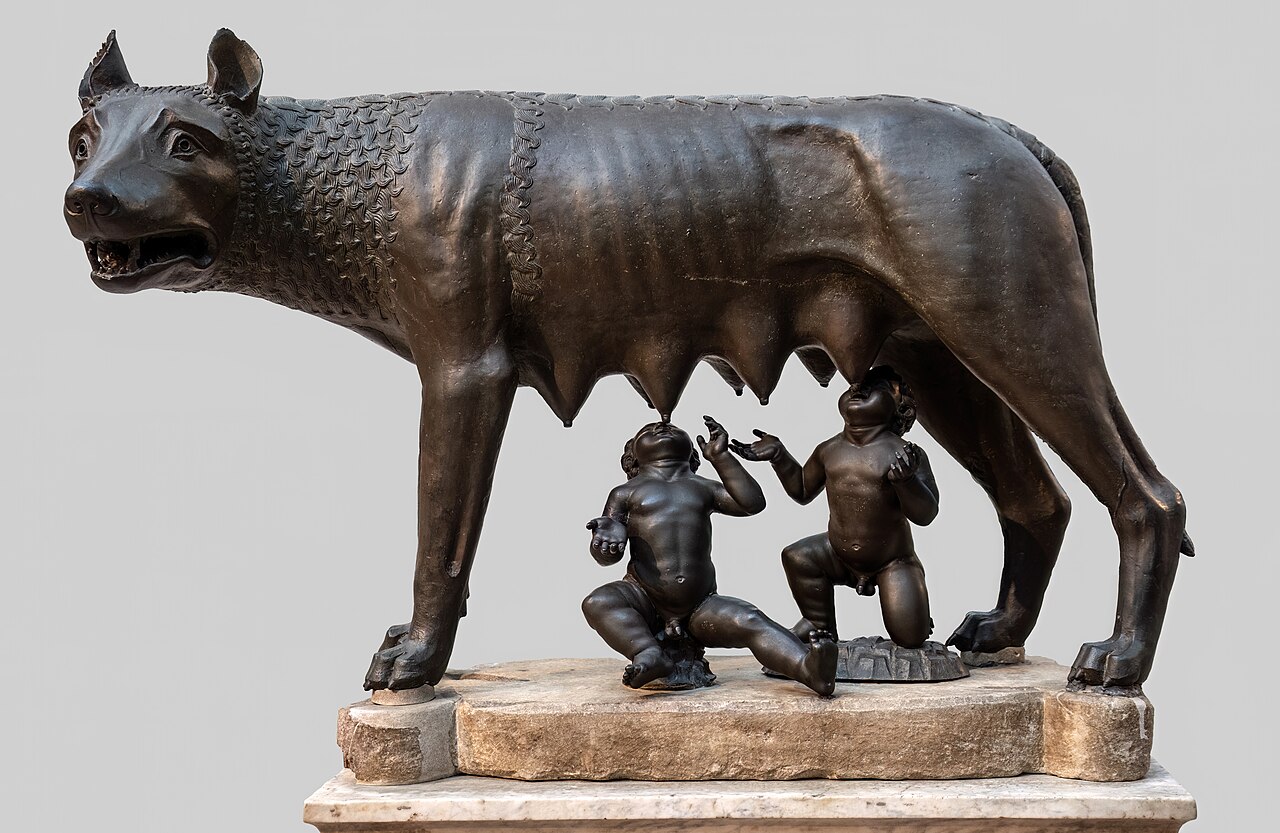
This is where the most famous image in the entire myth comes in. A she-wolf, drawn by the sound of crying infants, found the twins and instead of killing them, nursed them as if they were her own. Ancient sources add another animal to the scene as well. A woodpecker, sacred to Mars, is said to have helped feed and guard the twins alongside the wolf, a detail that reinforced the idea that Mars himself was watching over his sons even in their most vulnerable moment.
The image of the wolf nursing the twins became one of the most enduring symbols in all of Roman culture. A bronze sculpture known as the Capitoline Wolf, showing the she-wolf standing over the two infants, became closely associated with the city itself, and versions of the image appeared on coins, public monuments, and civic art for centuries. Modern scholarship has raised questions about the statue's exact age, with some research suggesting the wolf figure itself may actually date to the medieval period rather than antiquity, with the twin figures added later. Regardless of the statue's precise history, the image had already been fixed in the Roman imagination for a very long time before that particular bronze was cast.
Raised by a Shepherd
The twins didn't stay with the wolf permanently. A shepherd named Faustulus found them at the riverbank and took them in, raising Romulus and Remus alongside his own children as if they were simply more mouths to feed on a working farm. Faustulus's wife, Acca Larentia, is named in most versions as the one who actually raised the boys day to day.
Some later ancient writers offered a less mystical explanation for the wolf story itself. In Latin, the word "lupa" meant both female wolf and, informally, a prostitute. A few ancient authors suggested that Acca Larentia may have had a reputation that led to her being called a "lupa" in the more human sense, and that later storytellers, or simply the passage of time, transformed a woman with an unflattering nickname into an actual wolf in the retelling. Livy himself mentions this alternate explanation without fully committing to it, presenting the divine wolf story as the more commonly accepted version while acknowledging that a more ordinary explanation existed among some ancient sources.
Whichever version is closer to the truth, Romulus and Remus grew up as shepherds themselves, strong, capable, and, according to every ancient account, natural leaders among the other young men in the area. They gathered a following of local shepherds and, according to Livy, gained something of a reputation for boldness that bordered on lawlessness, getting into conflicts with bandits and neighboring herdsmen as they got older.
Discovering the Truth
Eventually, a conflict with a group of shepherds loyal to Numitor led to Remus being captured and brought before the very grandfather he didn't know he had. Numitor, looking at the young man in front of him, began to suspect the truth, helped along by the timing of Remus's age and the story of the abandoned twins that had circulated years earlier.
Romulus arrived to help free his brother, and between Faustulus's account of how he'd found the boys and Numitor's own suspicions, the truth came out. Romulus and Remus were Numitor's grandsons, the sons of Rhea Silvia, left for dead by Amulius years before. The brothers didn't hesitate once they understood who they were and what had been done to their family. They gathered their followers, moved against Amulius, and killed him, restoring Numitor to the throne of Alba Longa that had been stolen from him a generation earlier.
Founding a New City
With their grandfather restored to his rightful place, Romulus and Remus could have simply settled into life in Alba Longa. Instead, they decided to found a new city of their own, somewhere near the spot on the Tiber where they'd been left as infants and later raised by Faustulus.
This is where the story turns from triumphant to tragic. The twins couldn't agree on which of the seven hills the new city should be built on, or who should have the honor of naming and ruling it. Romulus favored the Palatine Hill. Remus favored the Aventine. Rather than settle the argument through simple agreement, the brothers turned to augury, a Roman method of divination that involved reading signs from the flight patterns of birds, to let the gods decide between them.
According to Livy's account, Remus saw six vultures first, taking his position on the Aventine Hill. Shortly after, Romulus saw twelve vultures from his spot on the Palatine. Both brothers claimed victory. Remus argued he'd seen his sign first. Romulus argued that a greater number of birds meant a clearer sign of favor. Neither side was willing to yield, and the dispute escalated from an argument about omens into open violence between their followers.
In the most common version of what happened next, Romulus began building a wall around the Palatine Hill to mark the boundary of his new city. Remus, mocking the low wall or its significance, or perhaps simply making a point about how easily it could be crossed, jumped over it. Romulus, in a fury, killed his own brother on the spot, reportedly saying that this was what would happen to anyone who dared cross the walls of his city without permission.
Other ancient accounts soften the moment somewhat, suggesting Remus was killed by one of Romulus's supporters rather than by Romulus's own hand, with Romulus grieving the loss of his brother rather than directly causing it. Livy himself notes both versions circulating in his own time, without fully resolving which was closer to the truth. Whichever version a given Roman audience preferred, the underlying fact of the myth stayed the same. Rome's founding involved the death of one twin at the hands of the other, whether directly or indirectly, and that fact was never hidden or edited out of the official story.
A City Built on That Contradiction
Romulus went on to found the city of Rome on the Palatine Hill in 753 BCE, according to the traditional dating worked out by later Roman scholars, and became its first king. He populated the growing city partly through the famous, deeply troubling episode known as the Rape of the Sabine Women, in which Romulus's men abducted women from a neighboring tribe to serve as wives, since the new city had far more men than women among its early population of exiles, runaways, and adventurers who'd been drawn to Romulus's growing settlement.
Romulus ruled for decades according to tradition, established many of Rome's early political and religious institutions, and eventually disappeared during a storm, with later Roman belief holding that he had been taken up and transformed into the god Quirinus, joining the Roman pantheon as a deity in his own right.
It's worth sitting with how unusual this founding myth actually is compared to a lot of other national origin stories. Rome didn't tell a story about peaceful settlement or divine gift-giving alone. It told a story that included exposure of infants, fratricide, and mass abduction, all within the first chapter of its own history, and treated that violent, complicated beginning as something worth remembering rather than something to quietly leave out.
Why the Romans Kept Telling It
The Romans weren't naive about what this myth said about their city. Livy, writing during the reign of Augustus centuries after these events supposedly took place, approaches the story with a historian's skepticism in places, noting where sources disagree and where divine explanations might really be covering for more mundane events. And yet he tells the story in full anyway, wolf, twins, and all, because by his time it had become inseparable from Roman identity itself.
The myth gave Rome a few things no gentler story could have provided. It gave the city divine ancestry through Mars, tying Roman military success directly back to the god of war himself. It explained the city's location specifically, rooted in the actual geography of the Tiber and the seven hills rather than some distant, symbolic homeland. And it gave Roman citizens a founding story that acknowledged, rather than concealed, the reality that their city had been built through struggle, conflict, and no small amount of violence between people who should have been on the same side.
Romulus killing Remus over a wall wasn't a flaw in the story that needed explaining away. It was the story's whole argument, made in a single violent act. Rome would defend its boundaries absolutely, even against family, even from the very first day of its existence. Whatever the actual historical truth behind Rome's founding centuries earlier, that message came through loud and clear every time the myth was retold, on coins stamped with the wolf and twins, in temples built to honor Mars, and in the words of historians who kept the story alive long after anyone could say for certain how much of it had ever really happened.