Ra and the Solar Journey
Ra wasn't one fixed figure the way later mythologies like their gods to be. He was a name attached to a process, and the process had stages.
Every morning, an old god is born again out of the eastern horizon, and every night he dies fighting a monster made of nothing. That's the deal the Egyptians believed kept the world turning. Not a metaphor they told themselves to feel better about sunrise — an actual, ongoing event, repeated without fail for as long as the cosmos had existed and for as long as it would continue to exist. Ra's day was the sky. Ra's night was a war.
A God Who Changes Shape With the Hour
Ra wasn't one fixed figure the way later mythologies like their gods to be. He was a name attached to a process, and the process had stages.
At dawn he was Khepri, the scarab-headed god who pushed the sun up over the horizon the same way a dung beetle rolls its egg-case across the ground — an image the Egyptians found less strange than we might, since they watched real scarabs do exactly that every day and saw in it a small, perfect model of the sun rolling itself into existence. At the height of noon he was Ra in full falcon-headed glory, sun disk crowning his head, riding highest and hottest. By evening, as the light went gold and low, he became Atum, the old god, the one who existed before anything else did, sinking back toward the horizon like a man walking home at the end of a long life.
Three names, one god, one day. And when the sun touched the western horizon, that day ended the only way it could: Ra died. Not symbolically. The Egyptians believed the sun's disappearance each evening was an actual death, and that in the morning an actual rebirth undid it. Which meant the twelve hours of darkness weren't simply the sun's absence. They were Ra's funeral, his passage through the land of the dead, and his resurrection, compressed into a single overnight shift that had to succeed every single time or nothing would rise the next morning.
The Boat That Carries the Sun
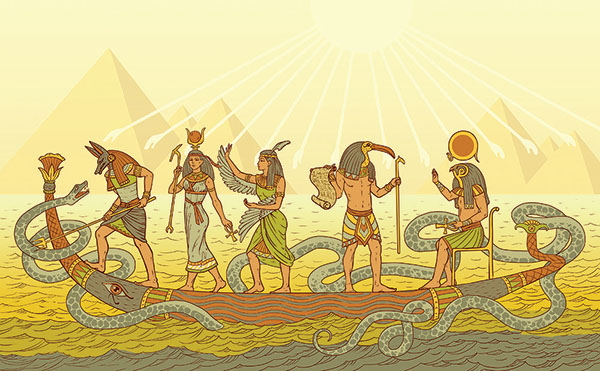
He didn't walk this journey. He sailed it, in a vessel called the solar barque — sometimes two barques, one for the day sky and a second for the night river that ran beneath the world, the Duat.
The barque wasn't crewed by nobody. Ra traveled in it surrounded by a full company of gods, each with a job. Thoth, god of wisdom and writing, kept the records of the passage. Ma'at, the personification of cosmic order, rode along as a kind of standing guarantee that the trip would stay lawful. And near the prow, doing the one job nobody else in the pantheon could do as well, stood Set — yes, that Set, the murderer of Osiris in the myths most people know him for — armed and waiting, because the boat's real cargo wasn't sunlight. It was survival.
The Enemy Waiting in the Dark
Every night, without exception, the barque met Apep.
Apep — sometimes called Apophis in the Greek-influenced spelling — was not a god in the usual sense. He wasn't born, didn't have a cult, wasn't owed offerings the way Ra or Osiris were. He was closer to a force than a person: an enormous serpent, sometimes described as long as the river itself, that existed for exactly one purpose, which was to swallow the sun and unmake the ordered world along with it. Where the other gods represented something — wisdom, order, fertility, judgment — Apep represented the absence of all of that. Isfet, the Egyptians called it. Chaos, not as an event but as a standing condition, always pressing at the edges of the world Ra's daily circuit held together.
Every night this fight happened again, at the same stretch of the underworld river, with the same stakes. And every night — so far — Ra's crew won. Set speared the serpent. Other accounts have magic doing the work: spells recited by Ra himself, or by the assembled gods, that bound Apep's coils and blinded him before he could get his jaws around the boat. The Egyptians even acted this out in temple ritual, priests reciting curses over wax models of the serpent and burning them, a piece of theater meant to lend real strength to the god's nightly battle by fighting a small copy of it themselves.
Apep never dies for good in any of this. He's cut, bound, blinded, driven off — and by the next evening he's back, whole, waiting at the same bend in the river. That repetition isn't a flaw in the storytelling. It's the point. Chaos in Egyptian thought isn't a threat you defeat once. It's a threat you hold off, forever, one night at a time, and the moment you stop showing up to the fight is the moment the world actually ends.
Twelve Hours, Twelve Gates
The night wasn't undifferentiated darkness. Egyptian funerary texts — the Amduat and the Book of Gates chief among them — mapped the underworld journey into twelve distinct hours, each with its own landscape, its own dangers, and its own cast of beings for the sun god's boat to pass.
Some hours were about labor: rowing through cavern rivers, past lakes of fire that punished the unrighteous dead, through regions guarded by serpents whose names had to be spoken correctly or the boat would be stopped cold. Names carried real power in Egyptian belief — to know a thing's true name was to hold some authority over it — so a large part of Ra's protection through the Duat came down to the correct recitation of who and what he was passing, hour by hour, gate by gate.
Other hours carried a different weight entirely. Deep in the journey, in the hour associated with the deepest midnight, Ra's soul was believed to merge briefly with the body of Osiris, lord of the dead, lying in his tomb within the underworld. This union — the sun god's life force meeting the dead god's stillness — was considered the actual mechanical moment of renewal, the point where death's raw material got converted back into the energy of a living sun. It's a strange, quiet image at the center of all that combat: not a battle won, but two gods touching in the dark, one giving the other what he needs to be born again by morning.
By the eleventh and twelfth hours, the boat was climbing back toward the horizon, the fight with Apep behind it, and the ordinary machinery of sunrise waiting to take over. Khepri would push the disk up. The falcon-headed noon self would rise. And everyone watching from the riverbanks of the actual, physical Nile would take that first line of light on the horizon as proof that, once again, order had held.
Why the Dead Wanted a Seat on This Boat
None of this stayed confined to theology for its own sake. Egyptians built their entire understanding of the afterlife around getting a place, even a small one, on Ra's boat.
To die well, in Egyptian belief, wasn't to escape to some separate paradise sealed off from the living world. It was to join the same daily circuit the sun god ran — to travel with Ra through the dangerous hours of night and come back out into daylight, over and over, forever. That's a big part of why Egyptian funerary texts read the way they do: as travel guides. The Book of the Dead, the Amduat, the Coffin Texts — they're full of the same information a living traveler might want before a dangerous trip. Which gate opens which way. Which guardian to address by which name. What to say if a serpent blocks the path.
Pharaohs in particular leaned on this connection hard. Royal tombs were built and decorated as literal maps of the solar journey, the burial chamber positioned to echo the deepest hour of the Duat where Ra meets Osiris, because a king's whole claim to legitimacy rested partly on being renewed the same way the sun was renewed — dying, passing through danger, and rising again with the authority to rule restored.
A God Who Needs the Fight to Mean Anything
There's something almost restless about Ra, compared to gods in other traditions who get to rest once they've done something impressive. Zeus doesn't refight the Titans every night. Ra fights Apep every single night, permanently, with no version of the myth where he wins for good and retires.
That's not a limitation in the storytelling — it's the actual argument the myth is making about how the world works. Order, in this framework, isn't a state you achieve and then keep. It's a maintenance job. Ma'at doesn't hold because it was established once at creation; it holds because somebody keeps choosing it over the alternative, hour after hour, gate after gate, all the way through the dark stretch of river where nobody watching from the daylight world can see how close it might be getting.
Which might be the real reason this myth outlasted so many others that got reshuffled or replaced across three thousand years of Egyptian religious change. Ra's story doesn't ask you to believe chaos was defeated once, long ago, and now everyone can relax. It asks you to notice that the sun came up again this morning — and to understand what that actually cost.